Hamilton Elite Roofing has spent more than 20 years on roofing in Upper Southampton and the surrounding stretch of Pennsylvania and New Jersey, and the question we hear most before a re-roof is not about shingles. It is about the contractor. Homeowners want to know who they are letting onto the roof, what that company has promised in writing, and who pays if something goes wrong on the job.
That question has a more specific answer here than in many places, because the township publishes its own paperwork for contractors on top of what the state asks for. This page walks through both layers, what each one actually covers, and how to use them to compare the companies bidding on your house. Neither layer tells you how well a crew installs a roof, but together they tell you whether a company is willing to be checked.
We start every job the same way regardless of paperwork. A leak call gets a look in the attic as well as on the roof, so the price follows the real point of entry, and you hear whether the roof can be repaired before anyone talks about replacing it.
Upper Southampton’s own contractor’s license
A township form, separate from the state
Upper Southampton Township keeps a contractor’s license of its own. The Department of Licenses and Inspections at 939 Street Road posts an Application for Contractor’s License, and the township’s 2026 fee schedule, Resolution #2026-11, lists that license at $125 per calendar year under a heading for contractor registration. The same office handles building permits, so a question about the license and a question about a permit for your roof go to the same desk.
What we could not confirm is whether the township currently enforces that license against roofers in particular. The form is what the township publishes; how it is applied to a re-roof is a question for Licenses and Inspections at 215-322-9700. If you are hiring, the phone call takes a few minutes and settles it for your job.
What the four-page application asks
The application runs four pages and is sworn before a notary. It asks for the trade name and years in business, city, state and federal identification numbers, the areas of work the contractor considers itself competent in, and whether any municipality has refused or revoked a similar license within the past two years.
It also asks about convictions related to work or contracts, the public liability insurance carrier and amount, and workers’ compensation coverage or a stated exemption. Read as a list, it is a useful outline of what any homeowner can ask a roofer directly, whether or not the township ends up requiring the form for your project.
The job list as a reference check
The most practical line on the form asks a contractor to list every job performed in the past three months, or the past ten jobs at minimum, with each customer’s name, address, telephone number and type of work. That is a reference list built into the paperwork. It is also the kind of list a company with nothing to hide can produce in an afternoon.
You can ask for the same thing. A roofer who can name recent jobs and put you in touch with those owners is giving you something you can check, and a drive past two or three of those roofs tells you more than a brochure. Ask how the cleanup went and whether the crew showed up on the days promised.
Looking for roofing closer to Delran? See Roofing in Delran.
Pennsylvania registration is not a roofing license
Registration with the Attorney General
Pennsylvania has no state roofing license. Home improvement contractors instead register with the Office of Attorney General under the Home Improvement Consumer Protection Act, usually shortened to HICPA. Registration is a record that the business has identified itself to the state; it is not a test of roofing skill.
That distinction matters when you read an estimate or a truck door. A registration number shows the company is on file with the Attorney General, which gives you a way to look it up. It does not mean the state has examined anyone’s work, so treat it as a starting point rather than a credential.
What a home improvement contract should carry
HICPA also governs the contract itself. We write contracts to the home improvement rules of the state the house sits in, and for a Pennsylvania home that includes the three-day cancellation notice. If a written agreement for your roof arrives without that notice, ask why before you sign it. The notice is there so a homeowner who signs under pressure has time to reconsider.
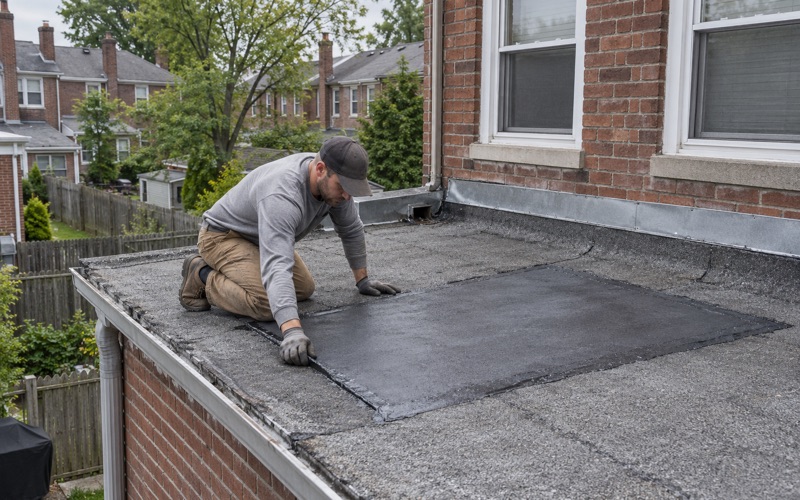
The scope inside the contract matters as much as the legal terms. Ours lists tear-off, decking, underlayment, flashing, ventilation and gutters as separate lines, so two bids can be laid side by side and compared item by item instead of as two totals that may cover different work. When one bid is far lower than the others, the line items usually show what it leaves out.
Checking both before you sign
In Upper Southampton, the sensible check before a re-roof covers both layers: the contractor’s registration with the Attorney General, and whatever the township asks of contractors working within its borders. Neither one replaces the other, and the township’s building permit application itself asks for the contractor’s license and insurance information.
A reputable company will not be annoyed by these questions. If a bidder cannot tell you its registration status or says the township has nothing to do with the job, that is a reason to call Licenses and Inspections yourself and get the answer from the source.
Insurance and workers’ compensation on a roof job
Liability coverage
The township’s form asks for a public liability insurance carrier, policy number, amount and policy period, and those are exactly the four things to ask any roofer for. A certificate of insurance sent directly from the carrier or agent is better than a photocopy handed over at the kitchen table. Call the agent listed on the certificate if anything about it looks out of date.
Liability coverage is what answers for damage to your property during the job, from a dropped bundle through a skylight to a tarp that fails in an afternoon storm. Check that the policy period covers the dates your roof will actually be open, not just the week the estimate was written. Separate from that, when a storm has already damaged a roof, we photograph and write up the damage for the owner’s own claim and will meet the insurance adjuster on site if asked.
Workers’ comp or a stated exemption
The application also asks for workers’ compensation coverage under the Pennsylvania Workers’ Compensation Law, or an exemption such as a contractor with no employees. If a company sends a crew of several people but claims the no-employee exemption, the numbers do not add up. The exemption is legitimate for a true one-person business, and a short question about who will be on your roof clears it up.
That gap is not a paperwork technicality. Roofing is physical work at height, and if a worker is hurt on your property, you want that injury handled by the contractor’s coverage rather than becoming a question for your homeowner’s policy. Ask for the workers’ comp certificate alongside the liability one.
Why coverage and safety go together
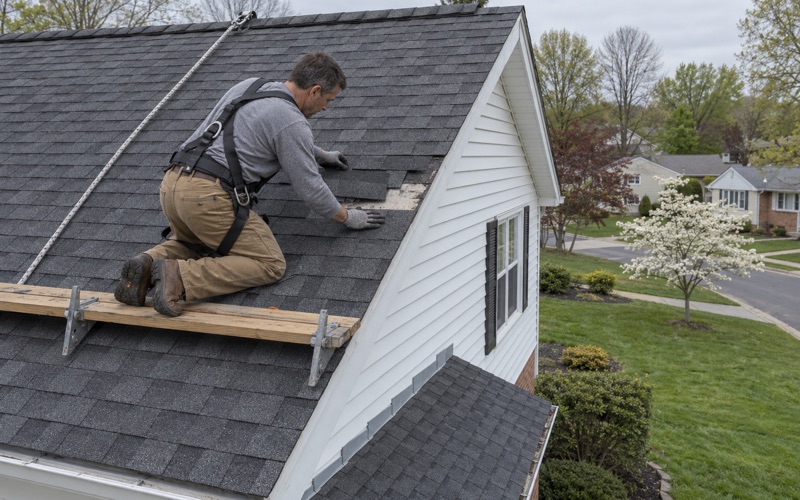
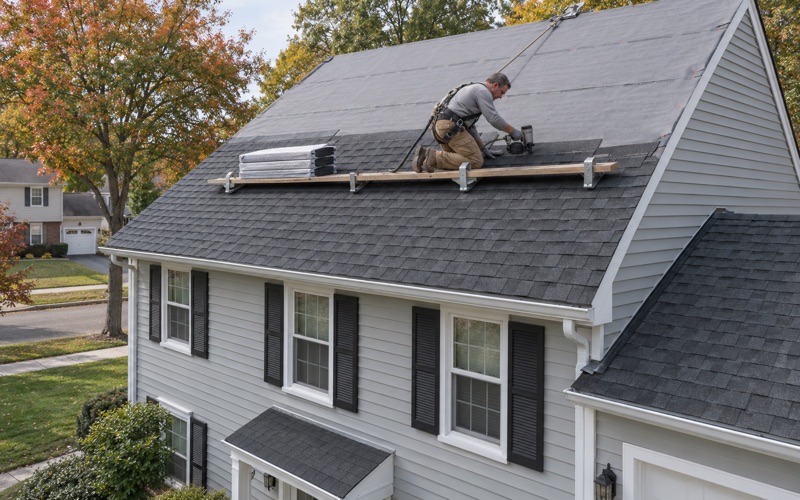
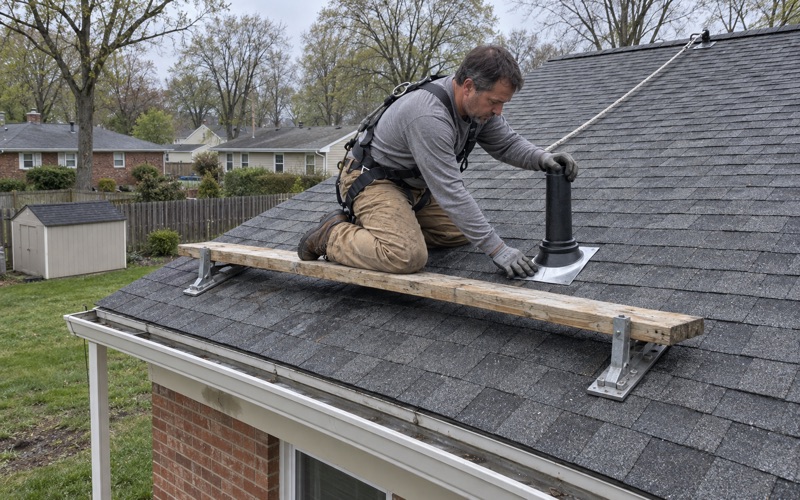
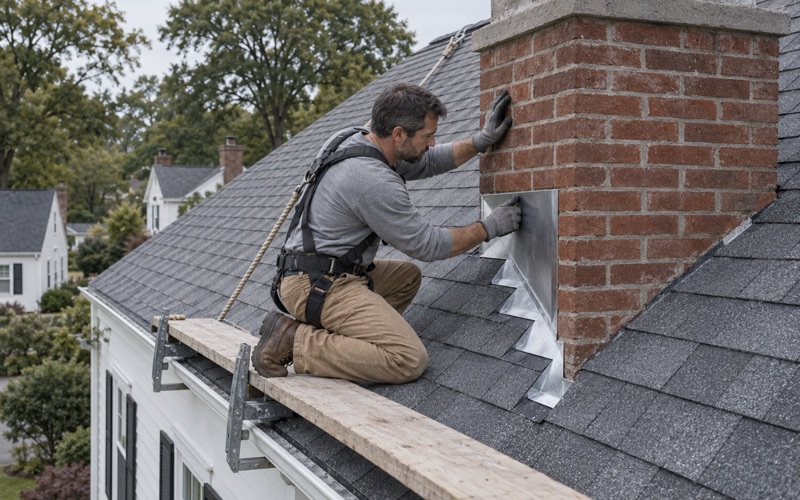
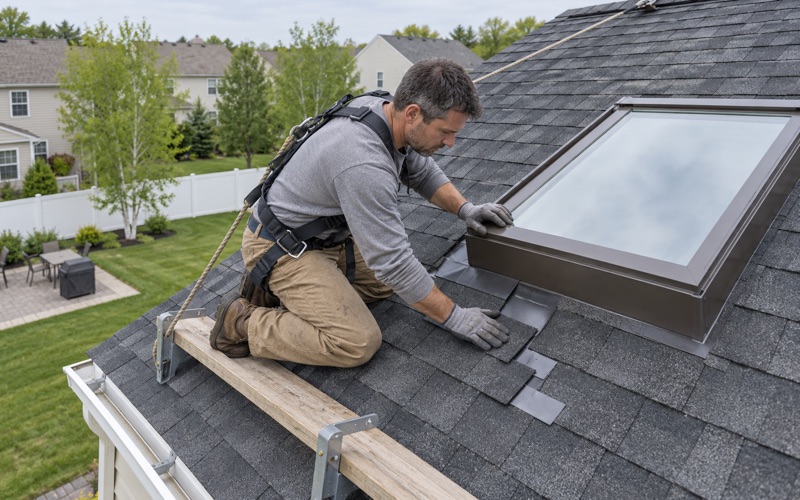
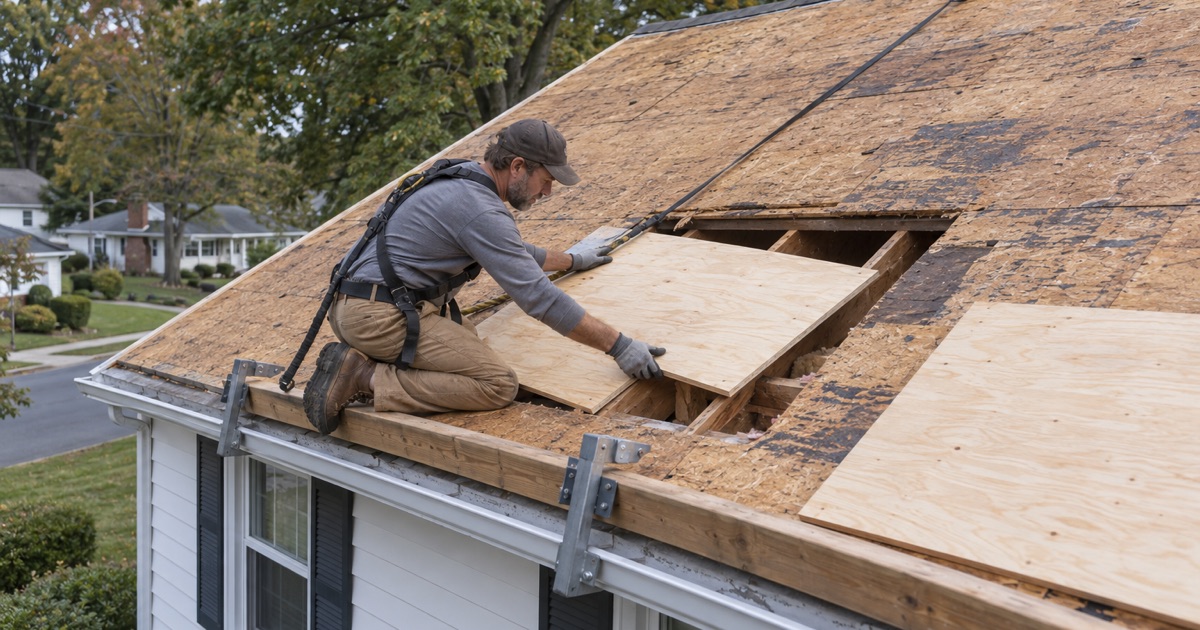
Federal rules require fall protection for residential roofing work at six feet and above under OSHA 29 CFR 1926.501(b)(13). A crew that sets up harnesses, anchors or other protection is working the way the rule expects, and that is visible from your driveway on the first morning. A crew working the edge of a roof with no protection in sight is a reason to ask questions about the rest of the job too.
We also clean the driveway, yard and gutters at the end of each work day, including a magnet sweep for roofing nails. Safety on a roof job extends to the family and the cars that use the driveway after the crew has gone home for the evening. Nails left in a lawn turn up later under a mower or a tire, which is why the sweep happens daily rather than once at the end.
The reroofing permit fee on Street Road
$125 per unit, and fees doubled without permits
The same Resolution #2026-11 carries a section for reroofing and residing. A residential reroofing permit is listed at $125 per unit, with non-residential work at 2% of total project cost or $225, whichever is greater, plus a $4.50 Uniform Construction Code surcharge per permit. Residential here means buildings governed by the International Residential Code, which covers a typical house.
The schedule also states that all fees in that section are doubled if a project is started without the applicable permits and approvals. That is a real cost to a homeowner if a contractor skips the step, which is one more reason to ask in writing who is responsible for pulling any permit the township requires.
Ask the township when a permit applies
We did not find the township’s own statement of exactly when a re-roof needs a permit, and permit rules for re-roofing in Pennsylvania are set by each municipality rather than by one statewide rule. The building permit application at 939 Street Road has no roofing checkbox, so the reliable answer comes from a call to the township before work begins.
If your house carries rooftop solar, the fee schedule lists solar at $20 per module, minimum $150, with a separate electrical permit. We plan panel removal and reinstall into the roof schedule from the start, so that work is part of the plan rather than a surprise on the day the crew arrives.
What else belongs in the plan
Of Upper Southampton’s 6,359 housing units, 4,829 are one-unit detached houses, so the typical job here is a single-family re-roof with its own gutters and flashing details. We replace step, counter and chimney flashing with the roof rather than reusing it, and we check attic ventilation on every replacement, because a roof that cannot breathe ages from underneath. Gutters and leaders are sized and pitched with the new roof as well, not left as an afterthought.
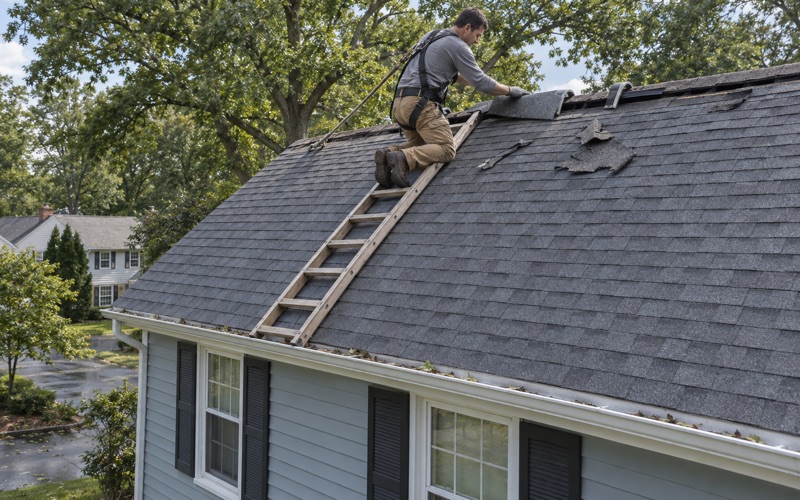
If damaged decking turns up once the old roof is off, we photograph it and show you before replacing it, at a per-sheet price already set in the contract. Nothing is torn out and billed before you have seen it. Between a contractor you have checked and a scope you can read line by line, there should be very little left to guess about on your roof.
- 20+ Years on the Roof
- Free Written Estimates
- NJ and PA Contracts