
Hamilton Elite Roofing has traced and repaired roof leaks in Hamilton, NJ for more than 20 years, and we answer leak calls in neighboring Bordentown Township, Robbinsville, Hopewell Township and Burlington as well. Every leak visit includes a trip into the attic, because the water stain on a ceiling almost never sits directly under the place where water gets in.
Leaks are frustrating precisely because the obvious fix often does not work. A roofer who patches the shingle above the stain without following the water can leave the real entry point untouched, and the stain returns with the next storm. We find the source first and only then price the repair.
Not every wet ceiling is a roof leak at all. Plumbing lines, HVAC condensate, a bathroom fan venting into the attic and winter frost on the underside of the deck all produce stains that look the same from below. Telling those apart is part of the job, and it saves owners from paying for roof work that would never have stopped the water.
How We Trace a Roof Leak
Starting in the Attic
With a light and a moisture meter we follow staining on the sheathing, rafters and insulation back to its highest point. Rusted nail tips, darkened plywood around a vent pipe or a wet line along a valley tell us where water is arriving. Daylight showing through a gap is the clearest evidence of all.
When the attic is finished or inaccessible, we work from the ceiling stain, the roof layout above it and the details nearby, and we tell you how confident the diagnosis is. Some leaks need a controlled water test from a hose, section by section, to prove which detail is failing.
Reading the Roof Above
Once we know the area, we inspect every detail in it: shingles, flashing, vents, pipe boots, valleys and the ridge. We look for lifted or cracked shingles, nails backing out, sealant that has pulled away from metal and flashing that was installed short or bent back on a past re-roof.
We photograph each suspect detail, so you see the same evidence we are basing the repair on. Those photographs also become a record for an insurance claim or for the next person who works on the roof.
Ruling Out Condensation and Plumbing
If the attic shows frost-like staining across a wide area rather than a single path, the cause is usually condensation from warm, moist air reaching a cold deck. That is a ventilation and air-sealing problem, not a shingle problem. Likewise, a stain under a bathroom often turns out to be a supply line or a wax ring rather than the roof above it.
Common Roof Leak Sources and Their Repairs
Chimney Leaks
Chimneys leak through failed counter flashing, cracked crowns, eroded mortar joints and missing crickets. Counter flashing set into a reglet can pull out as the chimney and roof move differently, and a chimney wider than 30 inches without the cricket required by IRC R1003.20 traps water and debris behind it. We repair whichever detail failed rather than coating the whole chimney in sealant.
A cracked crown lets water straight into the top of the chimney, where it soaks the masonry and shows up as a stain beside the fireplace or in the attic around the chimney chase. Repairing or recasting the crown, adding a cap and repointing the worst joints often stops what looked like a flashing leak, which is why we check the whole chimney before deciding.
Pipe Boots and Roof Vents
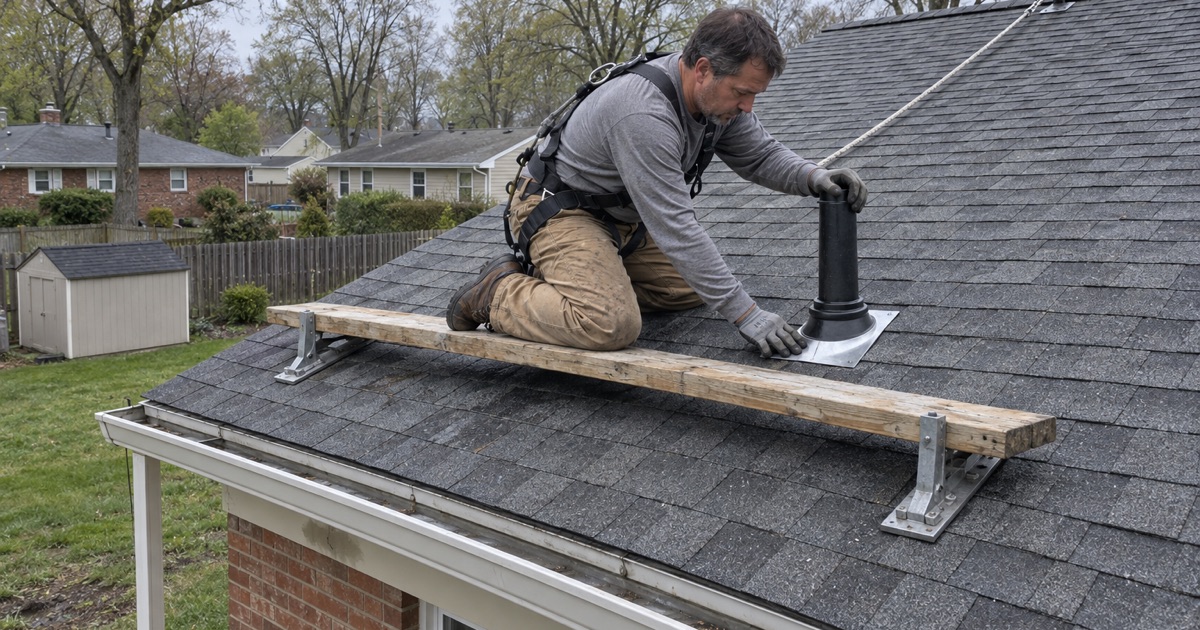
Rubber pipe boots split in the sun and let water run down the outside of the vent pipe. Box vents and ridge vents can leak when wind drives rain under them or when they were installed without enough overlap. We replace failed boots with new rubber or lead flashing boots and reset vents so the shingles above lap over their flanges correctly.
Valleys and Sidewalls
Valleys carry more water than any other part of the roof, and a valley where the shingles were cut too short or nailed too close to the center will leak in heavy rain. Along a sidewall, step flashing should be woven into every course of shingles, with counter flashing or siding over it. Where either was skipped, we open the area and rebuild it properly.
Rebuilding a valley or a sidewall means lifting the shingles on either side, replacing or adding the flashing, and laying the shingles back in with correct overlaps. It is more work than a surface patch, but it is the only repair that holds through the heavy storms that exposed the problem in the first place.
Skylight Leaks
Skylights leak at the curb flashing, at the glass seal or through condensation on the inside of the glazing. We check which it is before doing anything. Curb flashing can be rebuilt on its own, but a skylight whose seal has failed is usually better replaced, and that is something we tell you rather than patching around it.
Kick-Out Flashing and Hidden Wall Leaks
Where a roof edge ends against a wall, a small piece of kick-out flashing diverts water into the gutter. When it is missing, water runs down the face of the siding and into the wall cavity. These leaks often show up as stains on an interior wall or rot at the bottom of a window, far from the roof itself, and they are simple to prevent once found.
Seasonal Leaks in Hamilton Homes
Ice Dams Along the Eaves
In winter, heat escaping from the living space melts snow on the upper roof, and the meltwater refreezes at the colder eaves. The ridge of ice holds back water that then works under the shingles. We clear the immediate problem safely, and on any roof we replace we install ASTM D1970 self-adhering ice and water barrier along the eaves.
The longer-term fix is in the attic. Better air sealing, adequate insulation and balanced soffit and ridge ventilation keep the roof deck cold enough that snow does not melt unevenly. We check those conditions and tell you which ones are contributing.
Wind-Driven Rain
Strong storms push water sideways under shingle tabs and through gaps that stay dry in ordinary rain. Shingles that have lost their seal strip, a ridge vent with too little overlap or flashing that stops short of the edge are the usual culprits. Hand-sealing loose tabs and correcting the flashing details is usually enough to stop these storm-only leaks.
Gutter Backups
A clogged or undersized gutter can overflow behind itself and run water along the fascia and into the soffit. In winter the same gutter fills with ice and helps hold back an ice dam. We check gutter size, pitch and the drip edge relationship as part of every eave leak, because the fix may be at the gutter rather than on the roof.
After the Leak Is Fixed
Drying Out and Interior Repairs
Once the roof is watertight, wet insulation should be replaced and the drywall allowed to dry before it is repainted. We point out any decking or framing that stayed wet long enough to need attention, and we recommend waiting through a storm or two before cosmetic repairs, so you know the stain will not return.
When Repeated Leaks Mean a New Roof
If leaks keep appearing in different places, the shingles are brittle and the granules are gone, patching will cost more over time than replacing. We tell you that directly, with photographs, and we give you the repair option for the active leak so you can plan a replacement on your own schedule.
Keeping Records for Insurance and Resale
Keep the photographs and the written description of each leak repair. If the leak followed a storm, that record supports your own insurance claim, and we will meet the adjuster on site if you ask. If you sell later, it shows the buyer’s inspector exactly what was found and fixed rather than leaving an old ceiling stain unexplained.
- 20+ Years on the Roof
- Free Written Estimates
- NJ and PA Contracts