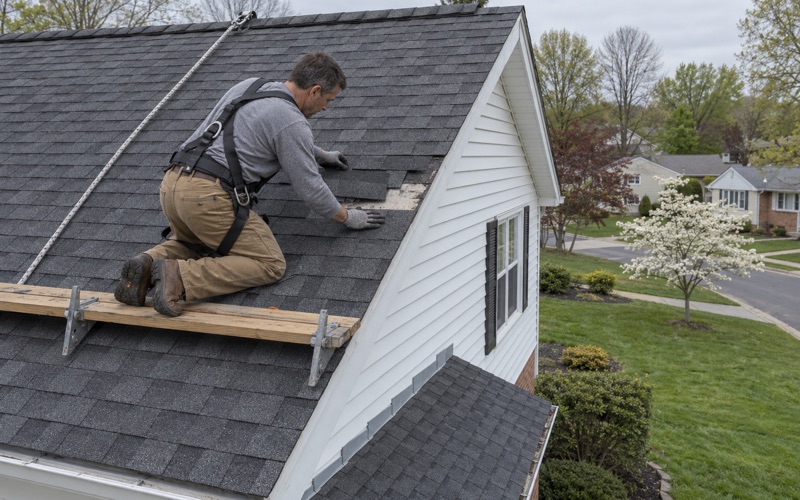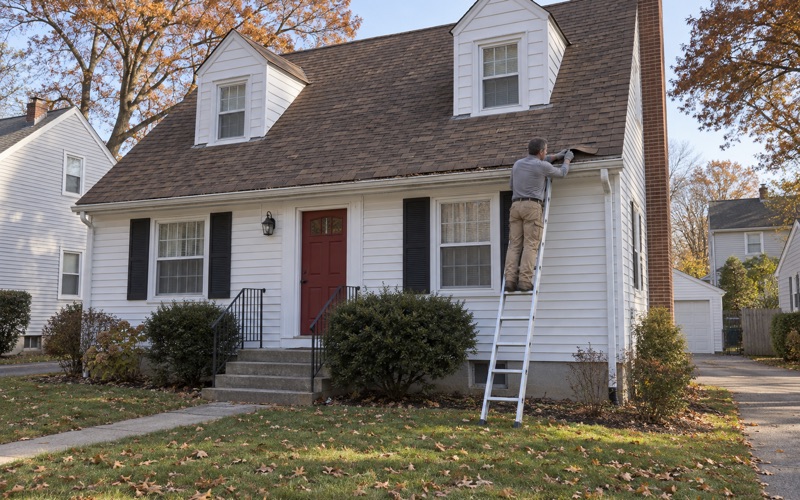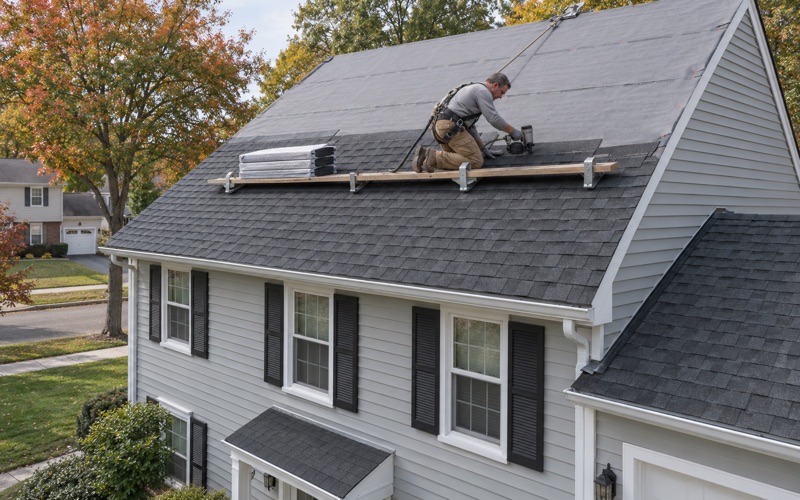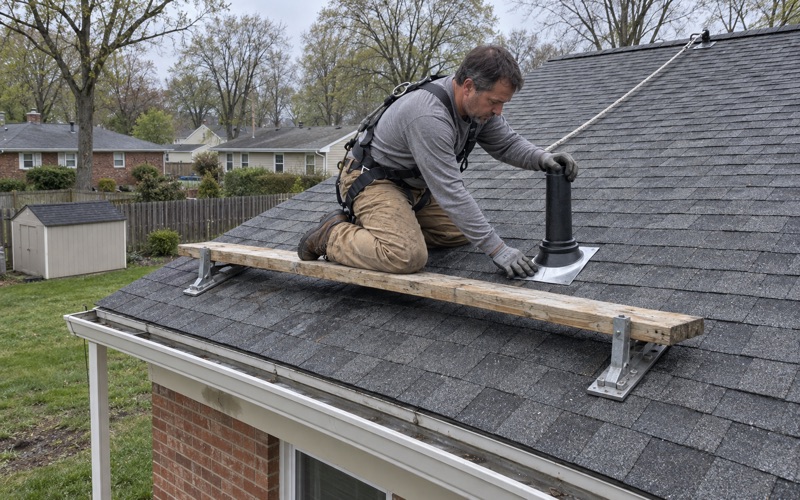
Hamilton Elite Roofing handles roofing in Millstone Township with more than 20 years in the trade behind every estimate, and most of the calls we take here come down to one question. Is this the house’s original roof, and has it reached the point where a first replacement makes more sense than another repair? We answer that from the attic as well as from the shingles, because a stain on a bedroom ceiling rarely sits directly under the spot where water gets in.
You will hear whether the roof can be repaired before anyone mentions replacing it. If a lifted shingle tab, a cracked pipe boot or a loose run of flashing is the whole problem, we say so and price that repair on its own. When replacement is the honest answer, the written scope breaks out tear-off, decking, underlayment, flashing, ventilation and gutters as separate lines, so a second estimate can be laid beside ours and compared one item at a time.
This page covers what is particular about re-roofing here: when the township’s houses went up, why so many of them reach the same decision in the same few years, and what a first re-roof on a large detached house actually involves from tear-off to the final cleanup.
Millstone’s Building Years and a Township That Aged Together
Most towns add houses at a steady trickle, so their roofs come due a few at a time. Millstone did something different. It built most of its housing in one concentrated stretch and then all but stopped, which means a large share of its roofs are getting older together.
The 1990s and 2000s Building Stretch
Census Bureau figures from the American Community Survey, 2024 five-year estimates, count 3,508 homes in the township. Of those, 2,266, or 64.6 percent, were built between 1980 and 2009: 408 in the 1980s, 1,173 in the 1990s and 685 in the 2000s. The 1990s alone account for a third of the housing in Millstone.
The population followed the same curve. The decennial census counted 5,069 residents in 1990, 8,970 in 2000 and 10,566 in 2010, growth that matches the decades when most of today’s houses were framed and roofed.
A Plateau After 2010
Then construction nearly stopped. The same survey counts only 58 homes built from 2010 to 2019 and none since 2020. The township’s own master plan reexamination presentation from May 13, 2026, shows the plateau in its population line: 10,566 in 2010, 10,375 in 2020 and 10,385 in 2024.
A township that stops building does not refresh its roofs through new construction. The housing stock simply grows older as a group, and the roofs on it do too.
What the Arithmetic Does and Does Not Tell You
A house built between 1990 and 2009 is now 17 to 36 years old. That puts a large share of Millstone homes, if they still carry their original roof, in the years when a first replacement usually comes up. The key word is if. Nobody keeps a record of which houses have already been re-roofed, so build dates tell you when to look, not what you will find.
Some owners replaced a roof years ago after a storm; others bought a house without knowing its roof history at all. The only way to know where a particular roof stands is to inspect it, which is where every one of our Millstone estimates starts.
Looking for roofing closer to Mount Holly? See Roofing in Mount Holly.
The First Replacement on a Builder’s Original Roof
A first replacement is a different job from a second or third one. The roof coming off is the one installed when the house was built, and the inspection has to settle whether it is truly near the end or just needs attention in a few places.
Repair or Replace, Answered First
Age alone does not condemn a roof. We look for the conditions that do: granule loss that leaves the mat exposed, shingles that have curled or cracked across large areas, repeated leaks at the same valley, and soft spots underfoot that point to decking trouble below. If those are absent, we recommend a repair and tell you what to watch for.
When several of them show up together, patching tends to chase leaks from one season to the next. That is the point where we lay out a replacement scope, along with photographs of what we saw so you can judge the reasoning yourself.
What the Attic Shows on an Older House
The attic often tells more about an original roof than the shingle surface does. Darkened sheathing around nail tips, staining along the rafters and damp insulation all show where moisture has been getting in or condensing over the years.
We check those spots on every leak call and every replacement estimate. On a house that has gone three decades without a re-roof, the attic is where we find out whether the decking can stay or whether some of it will need replacing once the shingles come off.
Paperwork for a Re-Roof in New Jersey
Replacing the roof covering on a detached one- or two-family house is ordinary maintenance under N.J.A.C. 5:23-2.7, so a straightforward re-roof of a Millstone home does not need a construction permit. Our contracts follow New Jersey’s home improvement rules, including the three-business-day cancellation notice.
A full replacement is also a capital improvement for sales tax purposes. We walk owners through Form ST-8, the Certificate of Exempt Capital Improvement, so the paperwork is settled before work begins rather than sorted out at the end.
Tear-Off, Decking and Ventilation on a 30-Year-Old House
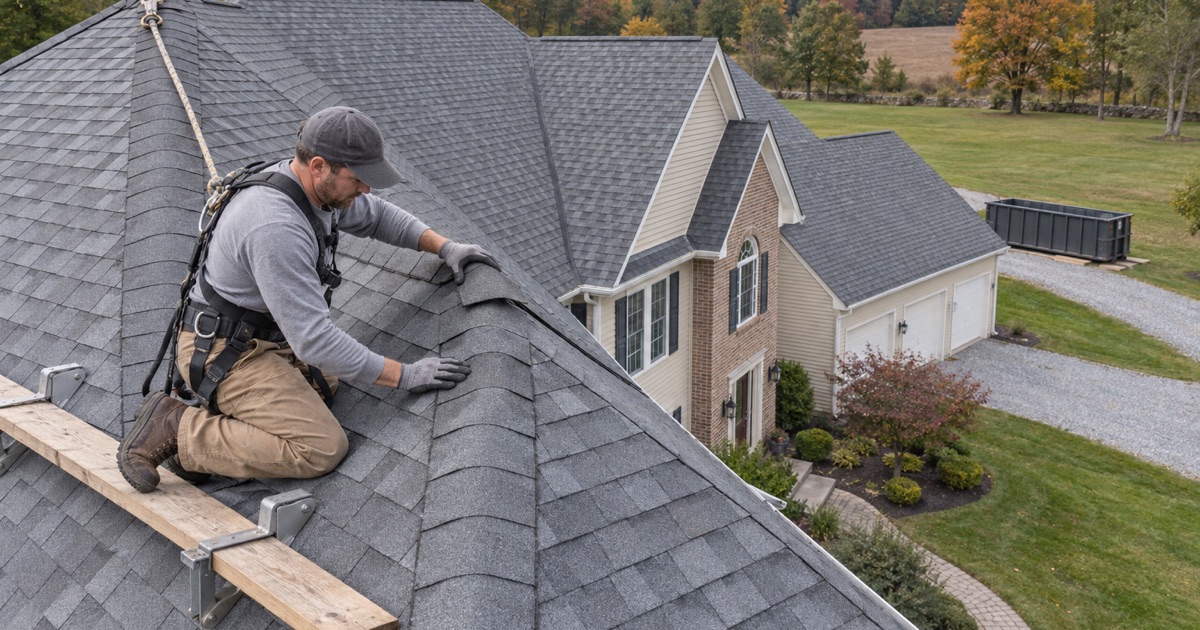
The work below the new shingles decides how long the second roof lasts. On a house reaching its first replacement, that means taking the original roof all the way down and correcting what three decades have done to the structure underneath.
Why We Tear Off the Original Roof
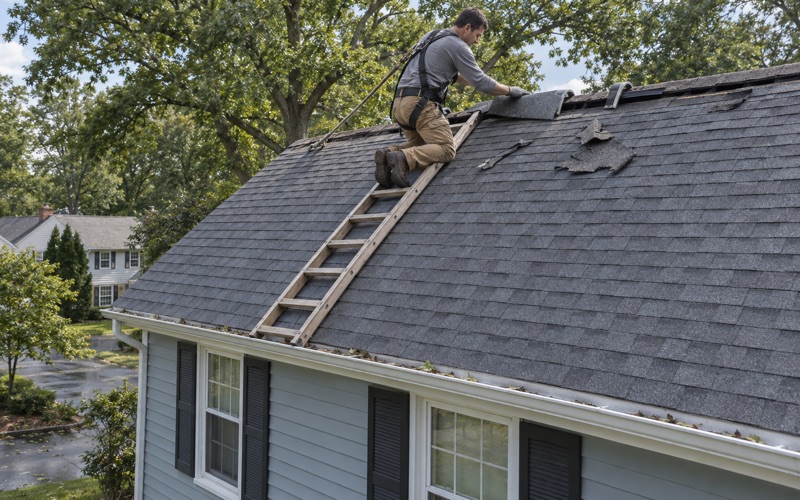
New Jersey’s rehabilitation subcode requires a tear-off once a roof already carries two or more layers, so a first re-roof is technically the one time an overlay might be allowed. We still price a full tear-off. Laying new shingles over old ones hides the decking, traps old flashing in place and adds weight the framing was never asked to carry.
With the original roof off, the deck is visible for the first time since the house was built. New drip edge goes on at the eaves and rakes, an ASTM D1970 self-adhering ice and water barrier goes into the valleys and along the eaves, and synthetic underlayment covers the rest before the architectural shingles go down.
Decking You See Before It Is Replaced
Damaged sheathing is the one cost no estimate can pin down before the old roof comes off. Our contracts set a per-sheet price for decking in advance. If we find soft or delaminated boards, we photograph them and show you before any sheet is replaced.
That way the final bill holds no surprise line. You see the damage, you know the price per sheet, and the count is agreed on the spot.
Flashing and the Ridge Vent
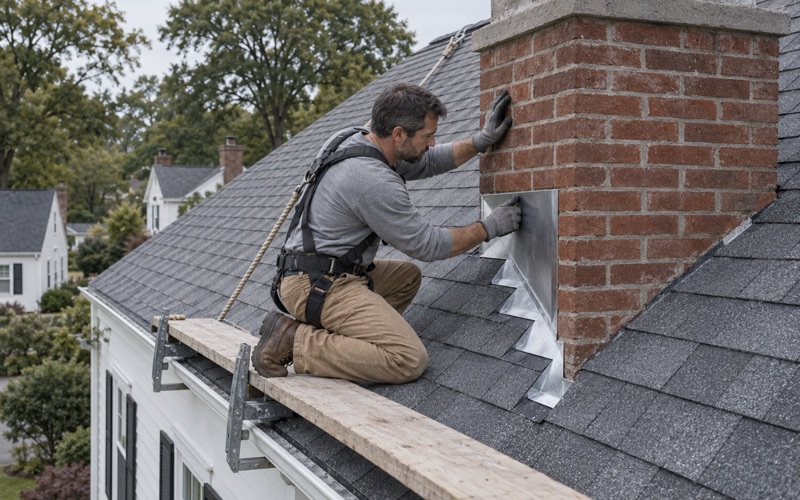
Step flashing along sidewalls, counter flashing at chimneys and the apron and kick-out flashing where roofs meet walls are all replaced with the new roof, never reused. Old flashing bent back into place under fresh shingles is a common source of the next leak.
Ventilation gets the same attention. Some older roofs were built with too little exhaust or with soffit vents covered by insulation. We check net free area on every replacement and balance a ridge vent against soffit intake, because an attic that cannot breathe ages the new shingles from underneath.
Large Detached Homes in Clarksburg and Perrineville
Millstone is a township of single houses. The 2024 survey counts 3,486 of its 3,508 homes as one-unit detached, and 3,287 of 3,352 occupied homes are owner-occupied. The median home has 10 rooms, and the township’s 36.61 square miles of land take in the post-office communities of Clarksburg and Perrineville.
Bigger Roofs, More Planes to Plan
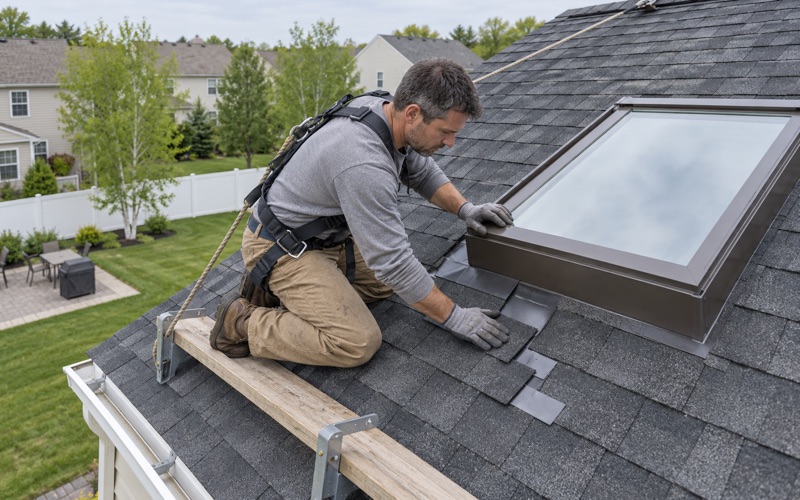
A ten-room house tends to carry a roof with several planes, valleys, dormers and at least one chimney. Each intersection is a place where water can find a way in, and each one gets its own flashing detail in the scope.
Where a chimney is wider than 30 inches, a cricket behind it sheds water around the masonry instead of letting it pool. We include the cricket, along with any crown or repointing work the chimney needs, as separate lines so you can see what each costs.
Gutters Sized With the Roof
A large roof sends a lot of water to the eaves in a heavy storm. Gutters and leaders on a re-roof are sized and pitched for the new roof’s runoff rather than reattached as an afterthought, and seamless aluminum runs avoid the joints where older sectional gutters tend to leak.
If the existing gutters are sound and properly sized, we leave them in place and say so. If they are undersized for the roof area they serve, the scope shows the change as its own line.
Cleanup Across a Big Lot
A tear-off on a house this size produces a lot of debris, and on a wide lot it can scatter well beyond the driveway. At the end of each work day we clean the driveway, yard and gutters and run a magnet sweep across the lawn for roofing nails.
If the house is going on the market, we also write a roof condition report the seller can hand to the buyer’s inspector. On an original roof in Millstone, that report answers the first question most buyers ask about a house of this age.
- 20+ Years on the Roof
- Free Written Estimates
- NJ and PA Contracts