Hamilton Elite Roofing brings more than 20 years of experience to roofing in Haddon, and on a replacement here the first piece of paperwork usually has nothing to do with shingles. It concerns the dumpster. Replacing the roof covering on a detached house in Haddon Township needs no construction permit, yet the container that carries away the tear-off can need a township permit of its own.
That permit runs on its own clock. The township asks for five days of processing before the start date, and each permit covers a set number of days on the ground. On a Haddon job, the container gets booked before the roof does, and the date on the permit shapes the date the crew climbs the ladder.
Our written scopes list tear-off, decking, underlayment, flashing, ventilation and gutters as separate lines, so you can hold two estimates side by side and see where they differ. In Haddon we also talk through the container early: where it will sit, how long it needs, and whose name goes on the application. The sections below walk through how that works.
No Permit for the Roof, a Permit for the Dumpster
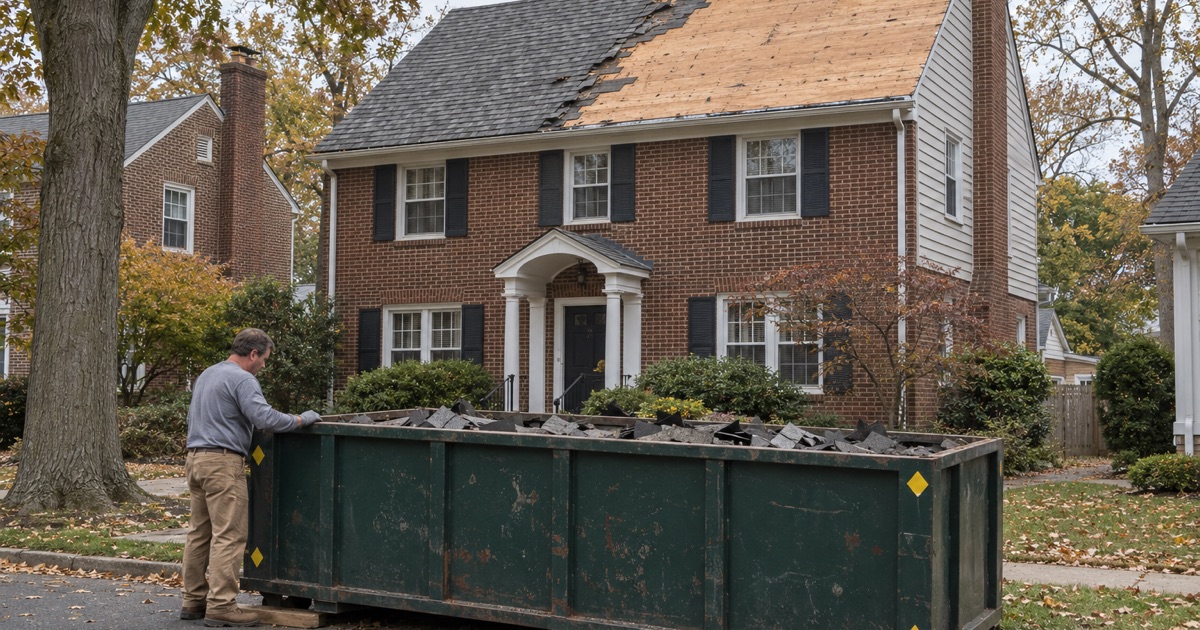
New Jersey treats the replacement of roof covering on a detached one- or two-family house as ordinary maintenance under N.J.A.C. 5:23-2.7. Haddon Township’s own residential permit guide restates the rule: work classified as ordinary maintenance does not require a construction permit. For most homeowners that is the end of the permit question for the roof itself.
What ordinary maintenance covers
The rule is about the house type and the work. A detached single-family or two-family home getting new shingles in place of old ones falls inside it. Buildings with three or more units, and mixed-use buildings, are outside that particular rule, so a different conversation applies there.
The township guide also notes that most exterior projects need zoning approval and that open permits must be closed before a home is sold. If your re-roof is part of a larger exterior project, the other pieces may carry their own requirements, and we would rather sort that out at the estimate than at the curb.
Why the container is a separate question
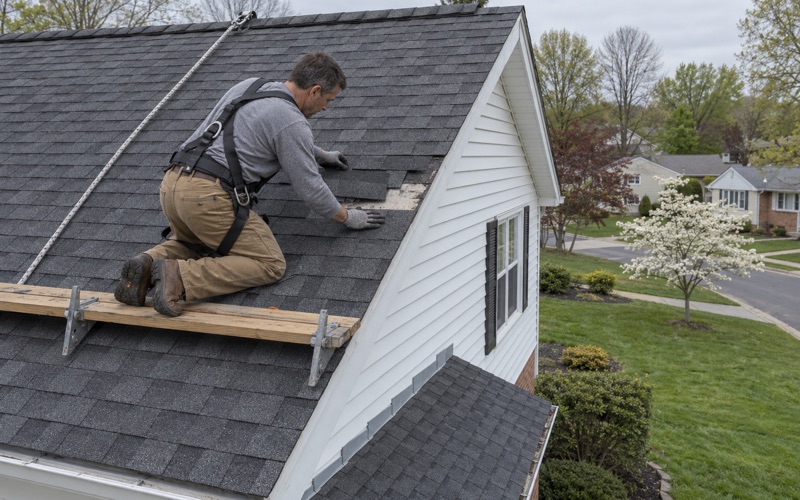
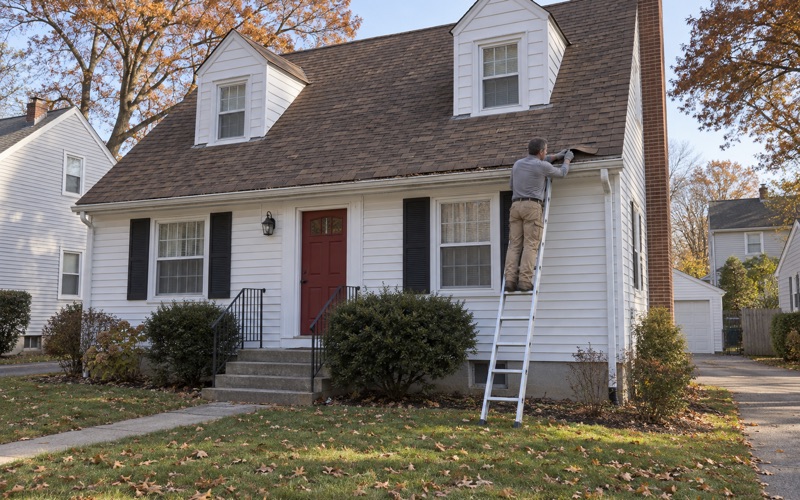
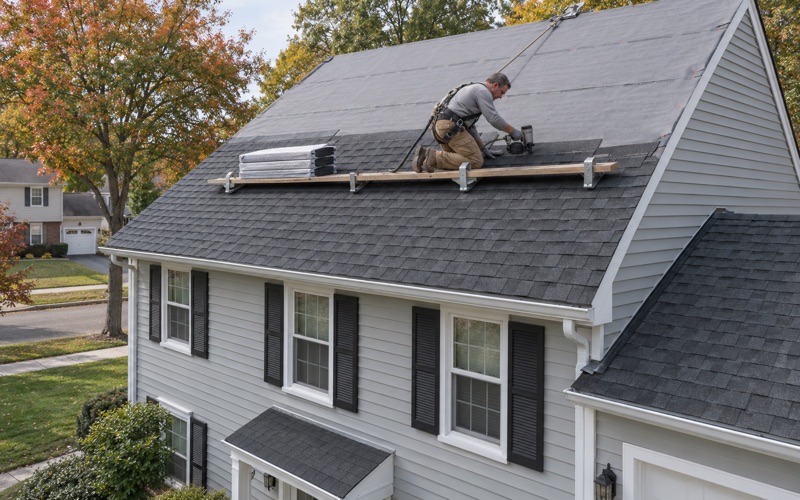
A tear-off generates a lot of material in a short time: old shingles, felt or synthetic underlayment, nails, damaged flashing and sometimes rotted decking. That material has to go somewhere, and on almost every replacement it goes into a roll-off container parked near the house for the length of the job.
The township regulates that container separately from the roof. Its Dumpster/Roll Off Container Permit Application, created in January 2026 and handled through the Construction Office at 10 Reeve Ave, asks for the property owner, the container owner and the location where the container will be placed. The applicant circles whether they are the property owner, the contractor, the tenant or someone else.
Why a tear-off fills a container fast
Much of the housing in Haddon Township is older. Census figures put 37.7% of housing units in the 1940-1959 range and 25.0% in 1939 or earlier. A roof on a house that age may have been covered more than once over the decades, and New Jersey’s rehabilitation subcode calls for a full tear-off when a roof already carries two or more layers.
We count layers before we price the job, because two layers of asphalt coming off weigh far more than one and can change the container size and how long it stays. When damaged decking turns up once the old roof is off, we photograph it and show it to you before replacing it, at a per-sheet price set in the contract.
Looking for roofing closer to Collingswood? See Roofing Services in Collingswood.
Where the Tear-Off Container Sits and How It Is Marked
Placement is the first decision in the dumpster plan, and in Haddon it carries real consequences. The township form says the container must be legally placed, approved and designated by township authorities, and equipped with appropriate reflectors.
Street placement
Where a house in Westmont, Crystal Lake or Oakdale has a driveway that is narrow, shared or too short to hold a roll-off and a work truck together, the street can look like the obvious spot. A container on the road, though, is exactly the situation the township form is written for.
Putting a container in the street means township approval of the exact spot, reflectors on the container and the permit displayed where it can be seen. It also means thinking about parked cars, neighbors’ driveways and the route the hauler’s truck needs to drop and lift the box without blocking traffic for long.
Driveway and private property
The application waives the fee for a container placed on private property. What the form does not spell out is whether a driveway placement needs the permit at all, so we do not assume either way. We check the current answer with the township before the container is ordered and plan around what we hear.
A driveway placement has its own practical points. Plywood under the container helps protect the surface, and the box has to sit where the hauler can reach it. We clean the driveway, yard and gutters at the end of every work day, including a magnet sweep for roofing nails, and the area around the container gets the same attention.
Reflectors and the state road rule
The township form calls for appropriate reflectors and a permit prominently displayed on the container. State law adds its own layer for roads. As quoted in municipal guidance, N.J.S.A. 27:5I-1 says a roll-off may not be left on a highway or public property without the written consent of the municipal, county or state authority, and that consent is valid for no more than 30 days.
The same statute, as quoted, calls for all-yellow reflective diamond panels at least 18 by 18 inches on both ends facing traffic, with the bottom edge at least 3 feet above the road. Those markings are the container owner’s equipment, but we confirm them when the box arrives, because a street container without them is a hazard at night.
Five-Day Permits and the Township Fee Ladder
The township sells container time in five-day blocks. Each permit is valid for five days with the permit displayed, and the fee climbs as the days add up. Knowing the ladder ahead of time keeps a schedule honest and keeps a surprise extension off the bill.
How the fees step up
The form lists the fees plainly: $25 for one to five days, $40 for six to ten, $55 for 11 to 15, $70 for 16 to 20, $85 for 21 to 25 and $100 for 26 to 30 days. A permit extension is $15 for each additional five days.
Those are modest sums next to the cost of a roof, but the dates matter more than the dollars. A permit that runs out while the box is still half full means arranging an extension mid-job, which is a distraction nobody needs while a roof is open.
Matching permit days to the real job
Most detached-house tear-offs move quickly once the crew starts, but weather, a second layer, decking repairs or chimney and wall flashing work can stretch the calendar. We estimate container days from the actual roof: its size, its pitch, the number of layers and how much flashing gets replaced.
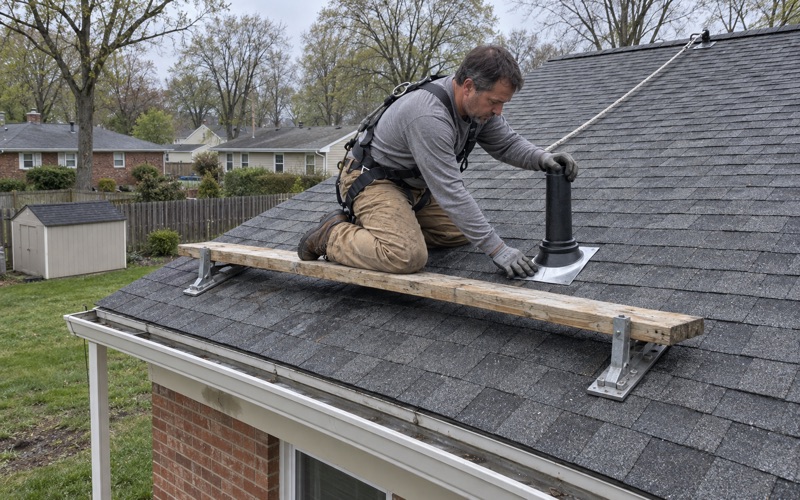
Step, counter and chimney flashing are replaced with the roof rather than reused under new material, and we check attic ventilation on every replacement. Those steps take time on the roof, so we build them into the container window instead of discovering them on day three.
Questions for the Construction Office
The township form points to Ordinance #1212 and article 186-10 for fees, fines, deadlines, responsibilities and violations. We have not read those sections, so we do not quote penalties or limits from them. If a question turns on the ordinance, the Construction Office is the place that answers it.
We would rather tell you plainly what we know and what we would need to check than give a confident answer built on a guess. The same goes for the roof itself: we give a straight answer on whether it can be repaired before replacement ever comes up.
Booking the Container Before the Tear-Off Starts
The line on the Haddon form that drives the whole schedule is the last one: please allow five days for processing prior to the start date. Put that next to the five-day permit blocks and the order of operations becomes clear. The container is planned first, the permit follows and the roof comes after.
A workable sequence
Once the estimate is signed, we settle where the container will sit, how many days it needs and who is applying. The application then goes in with at least five days of lead time before the delivery date, and the crew date is set to fall inside the permit window rather than before it.
If a storm or a material delay pushes the start, the container date and the permit date move with it. Re-roofing is easier to reschedule than a lapsed permit, so we keep both dates tied together and tell you when either one changes.
Contracts, cancellation and timing
Our contracts are written to New Jersey’s home improvement rules, including the three-day cancellation notice. That cancellation window sits at the very start of the process, and it is one more reason to begin the container conversation as soon as the scope is agreed rather than the week of the job.
If the roof is coming off because of storm damage, we photograph and write up the damage for your own claim and will meet the adjuster on site when asked. An insurance timeline and a permit timeline can run side by side, and we plan the container around both.
When the house is being sold
A re-roof often comes right before a listing, when a seller’s calendar is already full. If you are selling, we provide a written roof condition report you can hand to the buyer’s inspector, and we time the work so the container is gone and the driveway is clean before showings begin.
A roof in Haddon Township goes on the same way as anywhere else in New Jersey. What is different here is the paperwork around the container, and planning it five days ahead is what keeps the tear-off on schedule.
- 20+ Years on the Roof
- Free Written Estimates
- NJ and PA Contracts