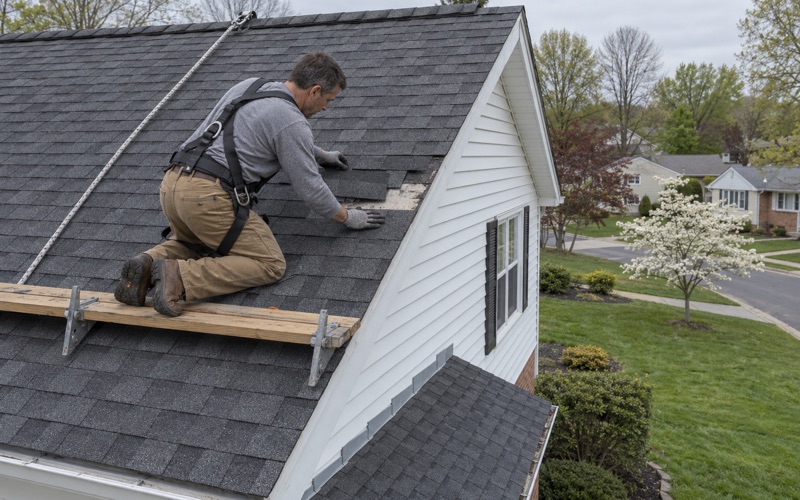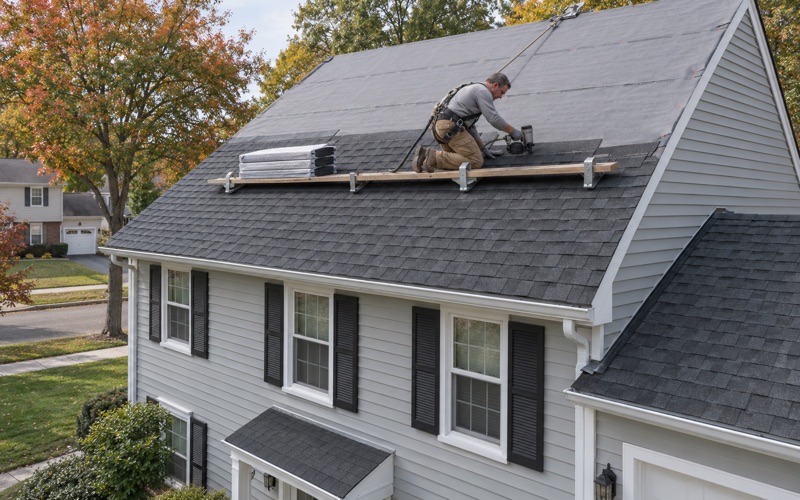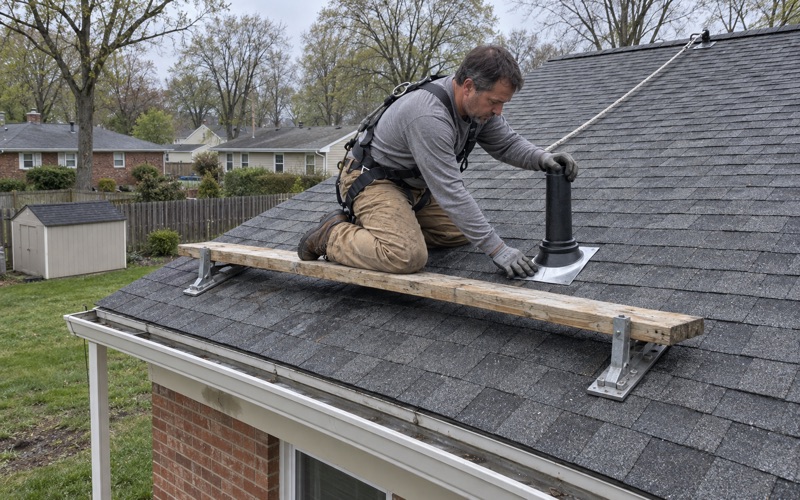
Hamilton Elite Roofing brings more than 20 years of work to roofing in Doylestown Township, and the part of a roof we look at hardest here is the small square where a chimney comes through it. The open field of shingles is rarely what fails first. The seams around a masonry stack, where metal, mortar and shingle meet at different angles, are where water most often finds its way into a house.
This page is about that junction: chimney flashing and counterflashing, the crown on top of the stack, the cricket that belongs behind a wide chimney, and how tall a chimney has to stand above the roof. It is also about a decision many owners face at re-roof time, when the heating system behind the chimney has changed, is about to change, or still runs exactly as it always has.
When a ceiling stain brings us out, we go into the attic as well as onto the roof, so the leak is traced to where it actually enters before anyone talks about price. You get a plain answer on whether the roof can be repaired before replacement is raised at all. When replacement is the right call, the written scope breaks out each part of the job so it can be compared line by line with any other estimate.
Oil and Propane Heat in Doylestown Township
The township sits beside Doylestown Borough, the county seat, and covers about 15.6 square miles drained by Neshaminy Creek, taking in villages such as Furlong, Fountainville, Edison and Dyerstown. Much of its housing went up between the 1960s and the 1990s, and a good share of those homes still make their own heat on site.
What the heating fuel numbers show
The Census Bureau’s American Community Survey (2024 five-year estimates) counts 6,535 occupied homes in Doylestown Township. Of those, 2,113, or 32.3 percent, heat with fuel oil or kerosene, and another 492 use bottled or tank gas, which most people simply call propane. Utility gas accounts for 2,076 homes and electricity for 1,753.
Oil and utility gas sit within the survey’s sampling error of each other, so neither can honestly be called the leading fuel here. What the figures do show is that roughly a third of households still burn fuel oil at the house itself, and that is something a roofer working in the township has to plan around rather than discover on the day.
Why a flue matters to the roof
An oil-fired boiler or furnace ordinarily vents its exhaust through a chimney or a lined flue, and that chimney has to pass through the roof somewhere. Every place the roof deck is cut open for a penetration has to be flashed and kept watertight for the life of the roof, and a masonry chimney is the largest of those openings on most houses that have one.
The census counts heating fuel, not chimneys, so we never assume a house has one or that it is still in use. We look. On an estimate visit we note whether a chimney is present, whether it still serves an appliance, and what shape the masonry is in where it meets the shingles, because each of those answers changes the scope.
Propane, heat pumps and a change on the way
Some owners are moving from oil to propane, to gas or to an electric heat pump, and some are only weighing it. A heat pump needs no flue at all, and a high-efficiency gas or propane appliance often vents through a plastic pipe in a side wall rather than up the old chimney. Either change can leave a masonry stack with nothing left to do.
That matters most when a roof replacement is coming. If the heating change is already on the calendar, the chimney question is best settled before the new shingles go on rather than a year afterward. Your heating contractor tells you what the new system needs for venting, and we plan the roof around that answer.
Looking for roofing closer to Bound Brook? See Bound Brook Roofing.
Where the Chimney Meets the Roof
Step flashing and counterflashing
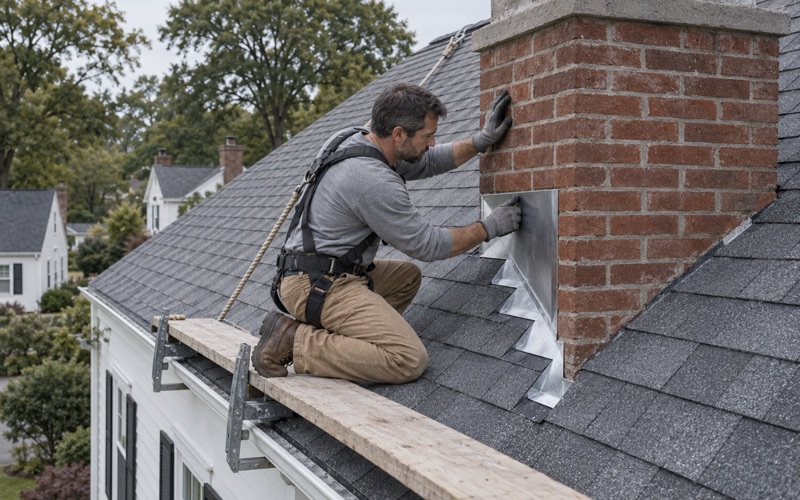
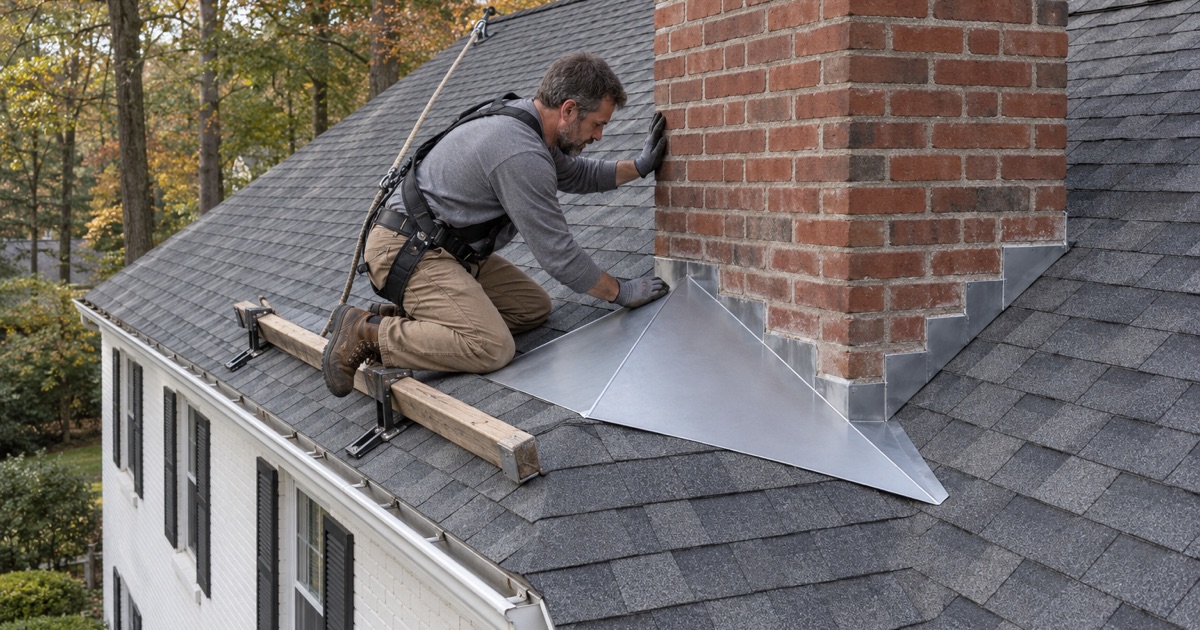
Chimney flashing is built in two layers that work together. Step flashing is a series of bent metal pieces woven in with each course of shingles along the sides of the stack, each lapping the one below it. Counterflashing is set into the brick, in a sawn reglet or a mortar joint, and folds down over the step flashing so water running down the masonry is carried out onto the shingles.
Across the downhill face of the chimney, an apron flashing does the same job. The two layers are kept separate on purpose: the roof and the chimney move independently as they warm and cool, and the overlap lets them shift without tearing a seam. A bead of caulk standing in for counterflashing is one of the most common failures we find on older roofs.
The crown, cap and mortar joints
Water does not only arrive from the roof side. The crown is the sloped slab of concrete or mortar across the top of the chimney, and once it cracks, rain soaks down through the masonry and can show up inside at a ceiling or along the chimney’s face in the attic. A metal cap over the flue opening keeps rain and debris out of the flue itself.
Open mortar joints near the roofline also let water slip past counterflashing that is otherwise sound. We note crown cracks, missing caps and joints that need repointing in writing, so you can see which items are roofing and which are masonry. We are roofers, not chimney sweeps, so the inside of the flue remains a question for a chimney professional.
Flashing is replaced, not reused
On every replacement we install new step, counter and chimney flashing rather than bending old metal back over new shingles. Flashing that has already been nailed, sealed and weathered for twenty years does not seat cleanly a second time, and the leak it eventually causes looks exactly like a failure of the new roof.
The flashing appears as its own line on the written scope, next to tear-off, decking, underlayment, ventilation and gutters, so you can see what each estimate actually includes. If damaged decking turns up around the chimney once the old roof is off, we photograph it and show you before it is replaced, at the per-sheet price already written into the contract.
The Cricket Rule and Chimney Height
Crickets behind chimneys wider than 30 inches
A wide chimney set partway down a slope acts like a dam. Rain and snowmelt coming down the roof pile up against its uphill face, and that pocket is where flashing is tested hardest. A cricket, sometimes called a saddle, is a small peaked frame built behind the chimney that splits the flow and sends it around both sides.
The Pennsylvania Residential Code, drawn from the 2021 International Residential Code, covers this in section R1003.20: a chimney needs a cricket where its dimension parallel to the ridgeline is greater than 30 inches and it does not intersect the ridge. We measure every chimney at the estimate, and when a wide one has no cricket, building one goes on the scope.
How a cricket is framed and roofed
A cricket is framed on the roof deck, sheathed, then covered in self-adhering ice and water barrier before it is roofed. Depending on its size and the pitch around it, the surface is finished in shingles or in sheet metal, and the small valleys on either side tie into the step flashing along the chimney.
The time to add one is during a re-roof, when the old shingles are already off and the deck behind the chimney is open. Retrofitting a cricket onto a finished roof means cutting into new material, which is exactly what a well-planned replacement is meant to avoid.
Chimney height above the roof
Section R1003.9 of the same code sets how tall a chimney has to stand. It must rise at least 3 feet above the highest point where it passes through the roof, and at least 2 feet higher than any part of the building within 10 feet. A stack that falls short can draft poorly, which concerns whoever maintains the heating appliance.
We do not judge whether a chimney drafts correctly; that belongs to a chimney or heating professional. What we can do is point out a short or crumbling stack before the roof goes on, because raising or rebuilding it afterward means disturbing flashing we just set. Doylestown Township Code and Zoning, at 425 Wells Road, can tell you whether planned chimney work needs a permit.
Re-Roofing Around a Chimney, Used or Not
A chimney that still vents heat
If the stack still serves an oil boiler or furnace, the re-roof has to keep it working and keep it dry. That means new step flashing and counterflashing, a cricket where the width calls for one, and ice and water barrier around the base before any shingle goes down. We also keep the flue opening protected from debris during tear-off.
Masonry problems we see at the roofline, such as a cracked crown or soft mortar, are best repaired before new counterflashing is cut into the joints. We tell you what we find so you can line up a mason or chimney professional ahead of the roofing day rather than after it. Attic ventilation gets checked on the same visit, since a roof that cannot breathe ages from underneath.
A chimney with nothing left to vent
When the oil system has given way to a heat pump or a sidewall-vented appliance, an unused chimney still has to be flashed, still needs a sound crown, and still collects water against its uphill side. Some owners keep it for the look of the house. Others have it taken down below the roofline so the deck can be closed over and shingled straight through.
Removing a chimney is masonry and possibly structural work, and whether it needs a permit is a question for the township, not one we answer for you. What we do is plan the roof around your decision, so the deck patch, underlayment and shingles go on as one continuous system instead of as a repair added a season later.
Chimney leaks that look like roof leaks
A stain on the ceiling beside a chimney can come from failed flashing, a cracked crown, water wicking through porous brick, or condensation inside an old flue. Each needs a different fix, and only some of them are roofing repairs. That is why every leak call starts in the attic, where the wet path along the framing usually shows where water enters.
Wind can loosen flashing and lift shingles around a stack, too. When that happens we photograph the damage and write it up for your own claim, and we will meet the insurance adjuster on site if you ask. Our contracts follow Pennsylvania’s home improvement rules, including the three-day cancellation notice, and the yard, driveway and gutters are cleaned and magnet-swept for nails at the end of every work day.
- 20+ Years on the Roof
- Free Written Estimates
- NJ and PA Contracts