Hamilton Elite Roofing brings more than 20 years of roofing in Delran and the towns around our Hamilton base to a question most roofers rarely face: where a new roof belongs when a house is being put back together after a flood. The answer depends less on shingles than on how the whole repair is weighed, and it is worth understanding before any estimate is signed.
Most roof calls are still the familiar kind: a stain spreading across a bedroom ceiling, shingles shedding granules into the gutters, a roof that has simply reached its age. Before anything is priced, we look in the attic as well as on the roof, so the water is followed to the place it actually gets in. You hear a plain answer on whether a repair will hold before replacement is ever on the table.
This page is about the other kind of call. For houses near the water, a roof decision can sit inside a much larger repair that is judged as a single total. Knowing how that works can change the order of the work, and what belongs in the estimate. The sections below walk through the river, the rule and where the roof fits.
Riverside Park, Where the Delaware Meets the Rancocas
A Township Named for Its Water
Delran Township takes its name from the two waters that meet at its edge: the Del comes from the Delaware River and the Ran from Rancocas Creek. It was incorporated on February 12, 1880, from portions of Cinnaminson Township. The township covers 7.25 square miles in Burlington County, 0.62 of them water. In Riverside Park, River Drive backs onto both.
That position is what sets the neighborhood apart. The Delaware is tidal along this stretch, so high water here rides in on the river’s tide and on storms pushing water up the Delaware, not only on heavy local rain. That is why the flood reports from Delran keep naming the same small part of town.
The Streets That Take the Water
When the river comes in, the same few streets keep turning up in the reports. In January 2024 the coverage put the worst of it on River Drive and on Alden and Stewart Avenues, where Delran Fire crews were out assisting residents. Officials told 6abc the neighborhood had flooded about 10 times since 2011, and that the January storm produced the worst damage.
Mayor Gary Catrambone told the station that even Superstorm Sandy was not quite as bad as the last one. Pointing at the shoreline, he described it as eroded to probably half of its original depth. The next step he named was an Army Corps study of this section of the river, which he said would take at least a year.
Questions We Ask in Riverside Park
On a roof call anywhere near River Drive, we ask a few things before we climb a ladder. Did the house take water in January 2024 or in an earlier flood? Is a flood repair underway, planned or still being priced? Has the township already been in touch about the damage?
None of that changes how the roof itself is inspected. It changes how the estimate is presented, because a roofing number that will sit beside a flood repair needs to be broken out cleanly and dated. An owner who expects a substantial damage review is better served by knowing that before the roofing contract is signed than after.
Looking for roofing closer to Southampton? See Roofing Services in Southampton.
January 2024: The Record Crest on the Burlington Gauge
What the River Reached
The National Weather Service tracks this part of the Delaware River at its Burlington gauge. On January 10, 2024, the river there crested at 11.99 feet, the highest reading on the gauge’s list of historic crests, though the figure is still marked preliminary. Officials counted 50 Delran homes impacted, and some residents were displaced after their homes were condemned.
The crests just below it are recent too: 11.94 feet on September 1, 2021, and the same height on April 17, 2011. Nine of the gauge’s ten highest crests fall in 2011 or later. That lines up with what the neighborhood describes, which is a flood that keeps coming back rather than one storm in a lifetime.
Reading the River by the Numbers
The gauge’s impact list says flooding begins in Delran, along with Beverly and Riverside, at 9.7 feet. At 9.9 feet it begins on the lower Rancocas Creek and its tributaries. The flood categories run from minor at 9.3 feet to moderate at 10.3 and major at 11.3, the level where widespread roadway flooding begins near the river and its tidal tributaries in Burlington County.
Delran falls in the National Weather Service’s Mount Holly forecast area, zone NJZ019, Northwestern Burlington. For an owner, the 9.7-foot line is the useful one. A river forecast that clears it means Riverside Park should expect water, and roof work underway on those streets should be planned around it, with materials kept off low driveways until the water drops.
The Township’s Own Long View
A Delran Township document titled Riverside Park Flooding, posted in October 2024, puts the problem in a longer frame. It states that sea level in the tidal Delaware River has risen approximately one foot since 1900, and it cites a projected rise of 1.4 feet from current levels by 2050. We have not read the full document, only those passages.
We are roofers, not hydrologists, and we draw no forecast from that. What it does suggest is practical: an owner on these streets planning a roof that should last decades is wise to plan it alongside whatever the house’s flood exposure turns out to be, rather than as a separate decision made in isolation.
Rebuilding After a Flood: The 50 Percent Decision
Who Makes the Call
For a damaged house in a mapped floodplain, the rebuild is not only between the owner and the contractors. Under FEMA’s substantial damage rule, the local floodplain administrator compares the cost of restoring the house to its condition before the flood with the building’s market value. When repairs reach 50 percent of that value or more, the house is treated as substantially damaged and flood-compliance requirements apply to the rebuild.
Delran’s flood insurance rate map has been effective since December 21, 2017, and the township is not in FEMA’s Community Rating System. We have not read Delran’s own flood damage prevention ordinance, and we cannot tell you which zone a given address falls in. The township’s floodplain administrator is the person who answers both questions. Ask early, because the answer shapes everything else in the rebuild.
Why the Roof Lands in the Total
This is the part that surprises owners. FEMA’s guidance on these decisions lists re-shingling among the improvements it counts when the work is done along with the flood repair. A roof replaced in the same rebuild goes into the same total as the drywall, the flooring and the mechanical systems. That list comes from FEMA’s own reference on substantial improvement and substantial damage, publication P-758.
A roof does not have to be touched by the flood to matter here. The issue is arithmetic: a roof that was already near the end of its life, folded into a large flood repair, adds to the figure the administrator weighs against market value. Whether that moves a house closer to the 50 percent line depends on numbers only the owner and the township will have.
What We Do, and What We Leave to Others
We do not make substantial damage decisions, and we do not handle flood insurance claims. What we can give you is a roofing figure that stands on its own, so the people weighing your rebuild are looking at a real number rather than an allowance buried in a general contractor’s total. If the roof can wait until the flood work is behind you, we will tell you that too.
Wind is a separate matter from rising water. If a storm has also torn shingles or lifted flashing, we photograph the damage and write it up for your own homeowner’s claim, and we will meet the adjuster at the house when you ask us to. That paperwork is ours to prepare; the claim itself stays yours.
Where a New Roof Fits in a Flood Rebuild
Repair, Replace or Wait
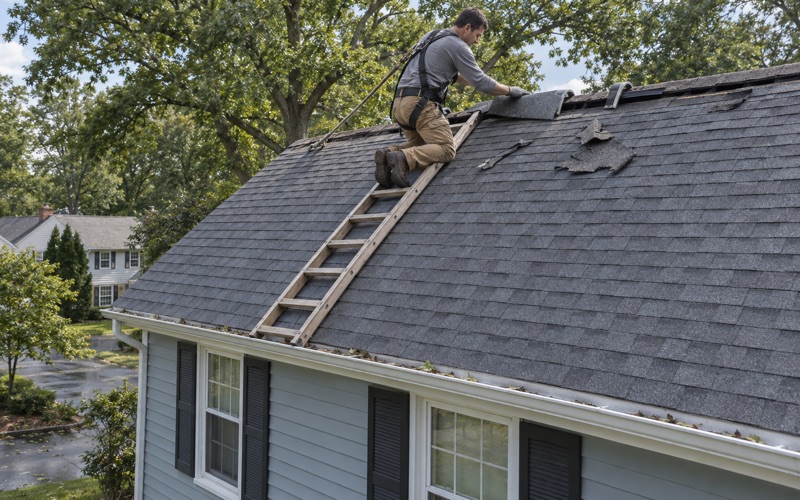
The first question is whether the roof needs replacing at all. If the shingles still have years in them and a leak can be fixed, we say so, and a repair is a far smaller line in any total. If the roof is genuinely worn out, the next question is timing: inside the same rebuild, or as its own project once the flood repair is settled.
That timing is for you to settle with the floodplain administrator, not a call a roofer should make for you. Our part is an honest account of the roof’s condition, from the attic side as well as the shingle side, so the choice rests on what is actually up there. If the attic shows staining or rot that predates the flood, you will see photos of it rather than a description.
A Scope Written Line by Line
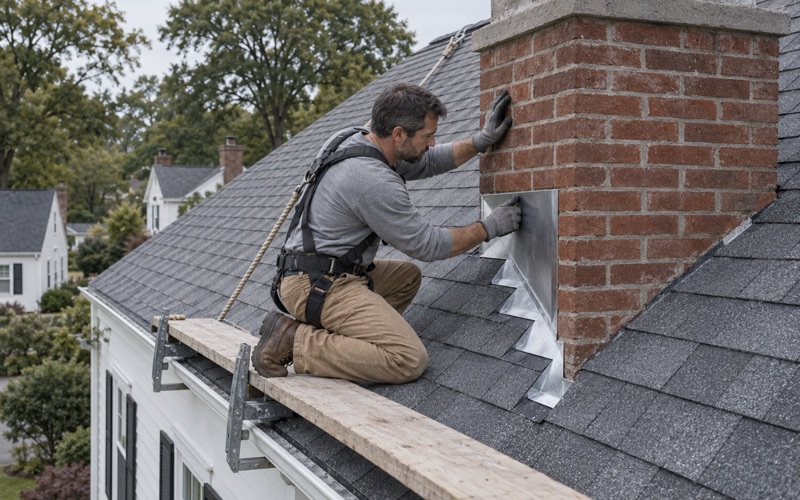
When replacement is the answer, our written scope breaks the job into separate lines for tear-off, decking, underlayment, flashing, ventilation and gutters. That lets two estimates be compared item by item, and it makes the roofing share of a larger repair easy to pull out. Step, counter and chimney flashing are replaced with the roof rather than reused under new shingles. A homeowner can hand that page to anyone checking the numbers.
Once the old roof is off, any damaged decking is photographed and shown to you before it is replaced, at a per-sheet price fixed in the contract. Attic ventilation gets checked on every replacement too, because a roof that cannot breathe ages from underneath. Gutters and leaders are sized and pitched as part of the same plan.
The Paperwork Around the Roof
Replacing the covering on a detached one- or two-family house is ordinary maintenance under N.J.A.C. 5:23-2.7 and needs no construction permit in New Jersey. That rule covers the roof alone. It says nothing about what the township asks of the flood repair around it, so keep both conversations in view.
Our contracts are written to New Jersey’s home improvement rules, including the three-day cancellation notice. At the end of each workday the driveway, yard and gutters are cleaned and swept with a magnet for roofing nails. On a street where neighbors may still be clearing out their own flood debris, a tidy site is the least a crew can leave behind.
- 20+ Years on the Roof
- Free Written Estimates
- NJ and PA Contracts