Hamilton Elite Roofing has handled roofing in Cinnaminson and across this part of New Jersey for more than 20 years, and much of the work we are asked about in the township now involves attached homes rather than freestanding ones. A townhome roof is not one owner’s decision, and the first thing we do is find out whose decision it actually is.
That changes the order of a typical visit. Before we measure a roof or price a single square, we ask to see what the association’s documents say about the roof over your unit. If the association holds it, an estimate written to you is wasted paper, and we would rather tell you so on the first call.
When the roof does turn out to be yours, or when the association brings us in, the work follows the same habits we use everywhere: a look in the attic as well as on the shingles for any leak, an honest answer on repair before anyone talks about replacement, and a written scope broken into separate lines you can hold against any other bid.
Cinnaminson Harbour, Built in Phases From 2005 to 2022
Cinnaminson Township sits in Burlington County along the Delaware River, an eastern suburb of Philadelphia. Most of its housing is older and detached, but the township’s newest association neighborhood, Cinnaminson Harbour, is a different kind of place to put a roof over, and it is the one this page is about.
Seventeen years of construction
Brokerage page text describes Cinnaminson Harbour as built continuously from 2005 to 2022. The homes are townhomes in interior rows and end units, plus a smaller number of flats, with two to four bedrooms. Garages are close to universal; basements are not.
A neighborhood built over seventeen years is really several neighborhoods sharing one name. The same page puts it plainly: a row on Lisa Way from 2005 and a row on Helen Drive from 2022 are different houses. For a roofer, that means roofs of different ages at different points in their working life.
What the listings say the fee covers
The listings do not agree on what the association fee buys, and that is the useful finding. A listing for a home on Helen Drive states that the HOA includes roof and exterior maintenance, along with snow removal, lawn care, the gym, the pool and the clubhouse.
Other listings, at a comparable monthly figure, describe common area maintenance and not much beyond it. On Lisa Way, listings name the Cinnaminson Harbour Carriage Homes Association with a fee of $391 a month. The brokerage summary sums it up in one line: the coverage tracks the phase rather than the address.
Why the phase matters more than the street
Two owners a short walk apart can hold very different roof obligations, and neither one can tell from the street. What decides it is the governing document for the section a unit was built in, not the curb appeal or the asking price.
We have not read any Cinnaminson Harbour declaration or master deed, and we will not guess what yours says. What we can do is point you to the right document and walk through its roof language before anyone climbs a ladder.
Looking for roofing closer to Lower Moreland? See Roofing Services in Lower Moreland.
One Roofline Over Several Owners
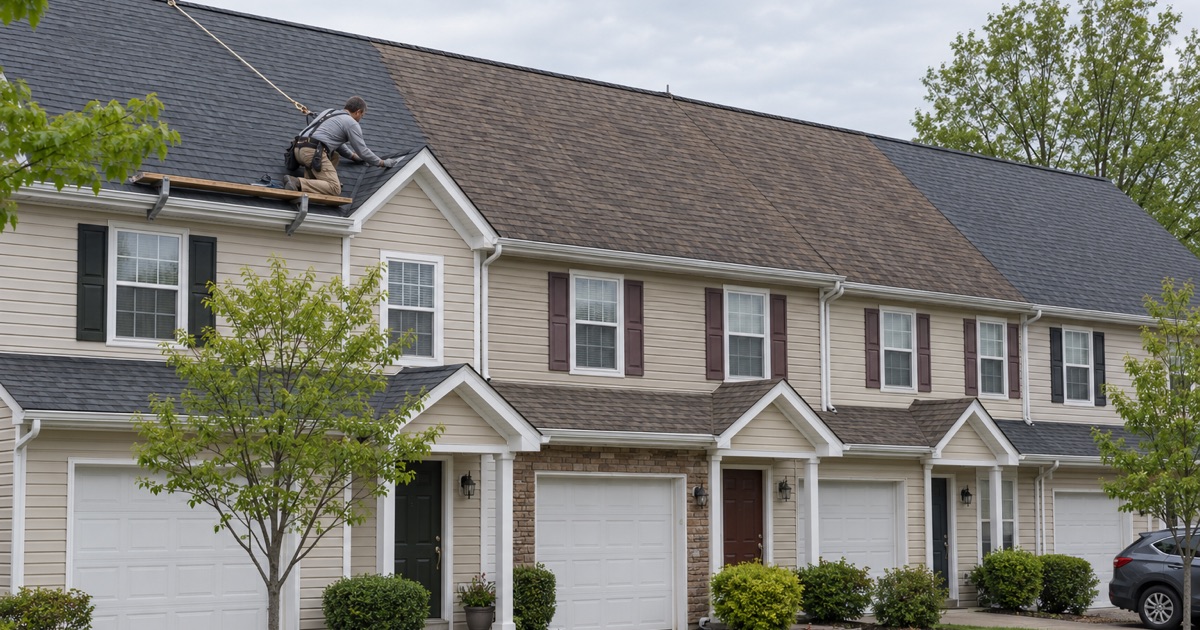
On a row of townhomes, the roof looks like one surface because it largely is one. The shingles run across property lines, the ridge is continuous, and water that lands over one unit can travel along a valley or a flashing seam before it finds a way in over another.
Interior rows, end units and flats
An interior unit shares a roof edge with a neighbor on both sides, so its roof cannot be treated as a stand-alone project. An end unit has one shared side and one exposed rake, which usually means more drip edge, more wind exposure at the gable and a different flashing detail where the wall meets the roof.
Flats add another layer, since one roof can sit over an upstairs owner and a downstairs owner. In every case, we plan an attached-home roof with the neighbors’ roofs and the shared wall in mind, because a tear-off that stops exactly at a property line leaves a seam that has to be detailed carefully.
Where a leak starts and where it shows
A stain on your ceiling does not prove the water entered above your unit. On a shared roofline it can come in at a neighbor’s pipe boot, step flashing or a tired section of shingle and follow the deck or a rafter bay before it drips.
That is why every leak call we take includes a look in the attic as well as on the roof. On attached homes the attic is where the trail shows up, and tracing the water to its actual entry point is what tells the association, or the owners involved, whose repair it is.
Matching materials across a row
A repair or partial replacement on a row should match what is already there in color, profile and exposure, or the row ends up with a patch that reads from the street. Phases built years apart may also carry different product lines, so matching one row does not mean matching the next.
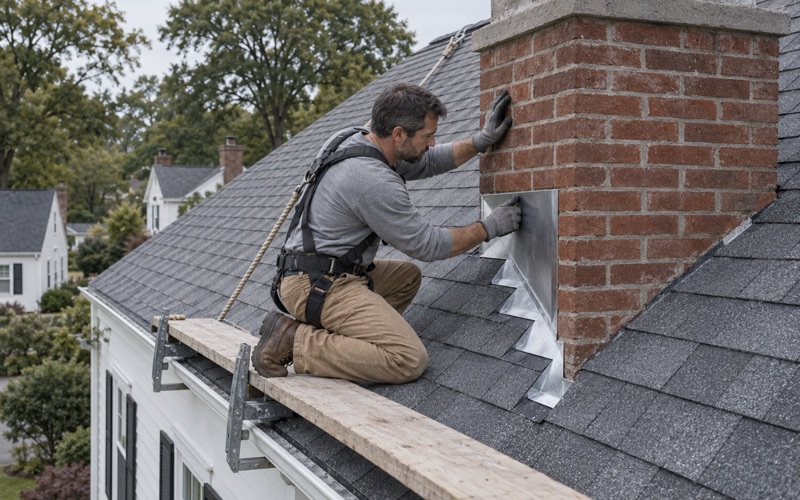
When a section is replaced, we replace the step, counter and chimney flashing with it rather than reusing old metal under new material. On a shared roof, the flashing at a party wall is often the detail that decides whether the new work stays dry.
Association Re-Roofs and Owner Leaks
In a community where the association holds the roofs, re-roofing tends to happen by building or by section on the association’s schedule, and an individual owner’s job becomes reporting problems and tracking them. Where the owner holds the roof, the owner still has to coordinate with neighbors who share it.
The 2027 listing note
One seller’s listing on Jason Drive states that the HOA plans to install new roofs around 2027, and mentions new Trex decks recently installed. That is one listing’s statement about one property, not a published association decision, and we treat it that way.
If you live in Cinnaminson Harbour and that line matters to you, the place to confirm it is your association or its property manager. Ask whether any re-roofing has actually been approved, which sections it covers and how the work would be funded, and get the answer in writing.
Reporting a leak through the association
If your association covers the roof, the leak report usually goes to the property manager first, not to a roofer. Keep photos of the ceiling, note the dates and weather when it appears, and ask for the work order number so the repair can be followed.
When an association brings us in for a leak on a row, we document what we find with photos and a written note of where water entered. That record helps the board decide whether it is a spot repair or a sign that the section is near the end of its life.
When the roof is yours
If your documents put the roof on you, you are the client, but your neighbors are still part of the job. We talk through how the work will meet the adjoining roofs, how debris will be kept off their property and when the crew will be on the shared ridge.
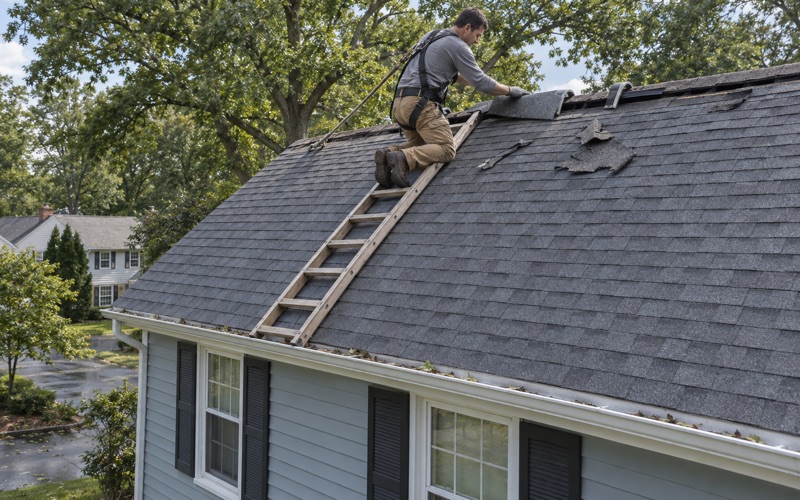
We will also tell you plainly whether the roof can be repaired before replacement comes up at all. On many attached roofs a failed boot or a short run of flashing is the whole problem, and a straight repair answer saves money for everyone on the row.
Questions to Settle Before a Townhome Roof Estimate
A good estimate on an attached home in Cinnaminson starts with paperwork, not a tape measure. A few questions answered first will save you, your neighbors and your association from paying for a bid that never gets used.
What to pull from the association’s documents
Ask for the declaration or master deed and the bylaws, and look for the section on maintenance and replacement of roofs and exteriors. Ask the property manager whether a capital reserve study has been prepared, since New Jersey planned real estate developments are subject to reserve study requirements under N.J.S.A. 45:22A-44.2.
We do not know what any Cinnaminson Harbour reserve study says, and we will not quote a figure from one we have not seen. If you bring them to the first visit, we will say whether an estimate addressed to you makes sense at all.
What our written scope shows
When an estimate is the right next step, our scope lists tear-off, decking, underlayment, flashing, ventilation and gutters as separate lines. That lets an owner, a board or a property manager compare two bids item by item instead of comparing totals.
Any damaged decking found once the old roof is off is photographed and shown before it is replaced, at a per-sheet price set in the contract. We check attic ventilation on every replacement, and contracts follow New Jersey home improvement rules, including the three-business-day cancellation notice.
Selling a Harbour townhome
Buyers in an association community usually ask two roof questions: what condition is it in, and who pays when it needs replacing. The second answer comes from the association’s documents, and the first is one we can put in writing.
For owners getting ready to sell, we prepare a written roof condition report you can hand to the buyer’s inspector. Paired with the association’s own answer on roof responsibility, it gives a buyer a clear picture instead of a guess.
- 20+ Years on the Roof
- Free Written Estimates
- NJ and PA Contracts