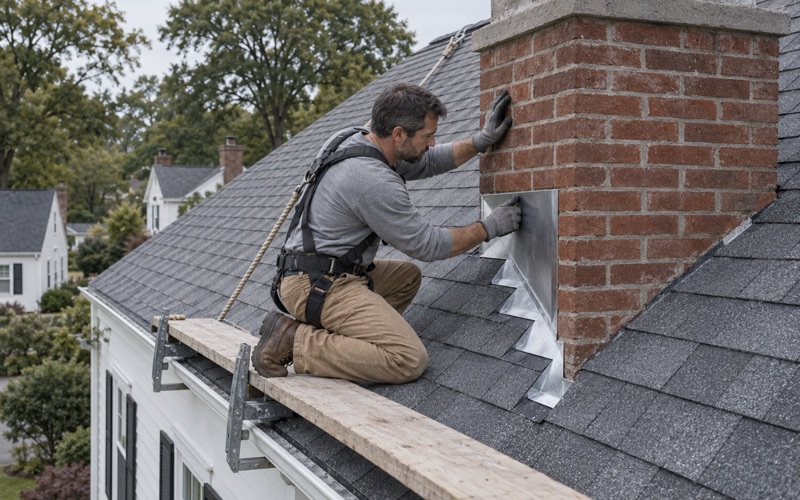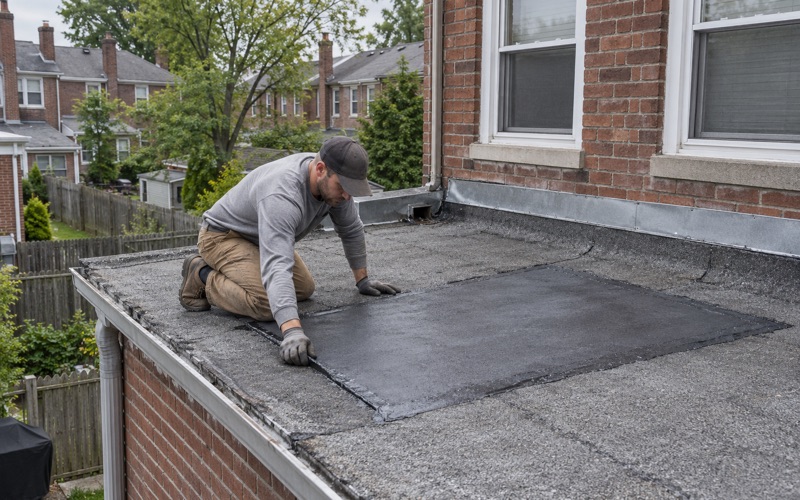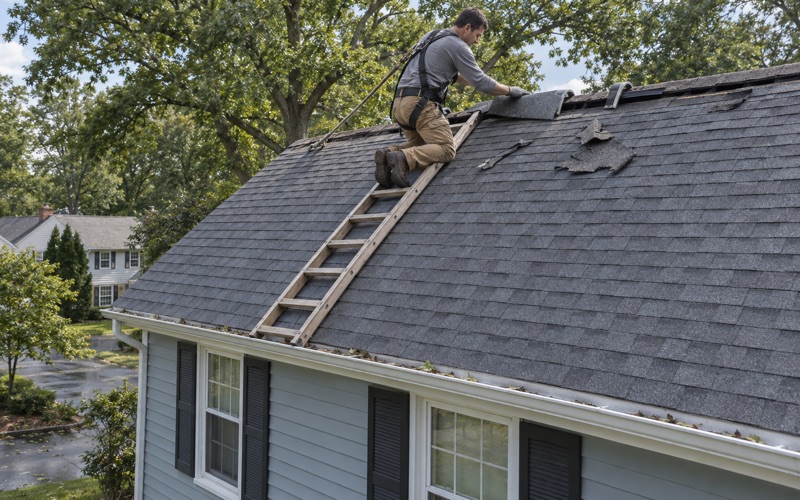
Hamilton Elite Roofing has spent more than 20 years on roofing in Bound Brook and across central New Jersey, and the calls we take here after a hard storm tend to start with the same question: whose policy pays for this? Before we talk coverage, we talk about the roof itself. Every leak call gets a look in the attic as well as on the shingles, so the water is traced to the spot where it actually gets in before anyone puts a number on the job.
That order matters because the answer to the money question depends on what failed. A lifted tab, a cracked pipe boot and a seam in old flashing can all send water down a wall, and each one points to a different fix. We tell you plainly whether the roof can be repaired before replacement ever comes up, and when it cannot, we say why in writing.
This page is about the part of storm season that confuses owners most in this borough: where flood insurance ends and the homeowners policy begins. It also covers how we photograph and write up roof damage so the record you hand your insurer is clear, dated and complete.
How the Green Brook Levees Changed the Flood Conversation
For most of its history, Bound Brook measured storms by the Raritan River. The borough sits along the river’s northern bank, and Main Street floods once the river reaches a 30-foot stage. Hurricane Floyd pushed the Raritan to a record 42.13 feet at Bound Brook on September 17, 1999, and floodwater stood 12 to 15 feet high inside the Brook Theater’s auditorium.
The levees and floodwalls finished in 2016
The U.S. Army Corps of Engineers answered with the Green Brook Flood Control Project. Completion of the works near Bound Brook was marked in August 2016: a $143 million system that includes 8,500 feet of levees, two floodwalls and two pumping stations. Closure gates span the NJ Transit tracks on the western side and the South Main Street railroad underpass, and the R2 levee keeps the Raritan out of downtown.
For a roofer, the levees matter less for what they hold back than for what they changed on paper. Once the system was finished, the insurance requirements that had followed many borough properties began to shift, and that shift is where a lot of today’s roof-claim confusion starts.
About 500 properties and the July 2016 change
A July 2016 feature from the Corps’ New York District reported that flood insurance requirements changed in the Borough of Bound Brook that month. Mayor Robert Fazen was quoted saying that approximately 500 properties would no longer be required to pay flood insurance. That figure is the mayor’s estimate from 2016, not a map we have read for your street.
We raise it because owners sometimes connect the levees and the insurance change in a way that leads to trouble. A requirement going away is not the same as a risk going away, and whether any one house still carries flood coverage is a decision for the owner and an insurance professional. Our concern is narrower: none of that history changes how a roof claim works.
Looking for roofing closer to Plumstead? See Roofing in Plumstead.
What Flood Insurance Never Covered on a Roof
Even in the years when flood insurance was required across much of the borough, the flood policy was never the one that paid for water coming through the roof. The National Flood Insurance Program defines a flood as a general and temporary inundation of two or more acres of normally dry land, or of two or more properties, one of which is yours. Rising water from the Raritan fits that definition; a rainstorm overhead does not.
Rain driven in by wind is not flood damage
The NFIP’s own wording is direct: damage from rain that is propelled into a home by winds, or that enters through a damaged roof, is not covered by flood insurance. A nor’easter that peels back a row of shingles and soaks a bedroom ceiling is, in flood-insurance terms, not a flood at all, however much water came in.
FEMA’s fact sheet on wind versus floodwater adds the other half of the picture, noting that homeowners policies may cover damage from wind-driven rain. That is why the roof side of a storm is a question for the homeowners carrier, whether or not a flood policy was also in force on the same house.
Why the distinction still matters here
When a big storm brings both river water and wind, a Bound Brook house can see two kinds of damage at once: water at the foundation and water through the roof deck. Those are separate questions, handled under separate policies, and mixing them up slows everything down. An adjuster looking at a stained ceiling wants to know where the water entered, not how high the river got.
The borough’s flood list is long: 1938, 1955, 1971, 1973, 1996, April 2007, March 2010 and Irene in August 2011, besides Floyd. Several were tropical systems that arrived with wind as well as rain, which is exactly when an owner ends up with river questions and roof questions in the same week. Sorting them early keeps each claim with the right carrier.
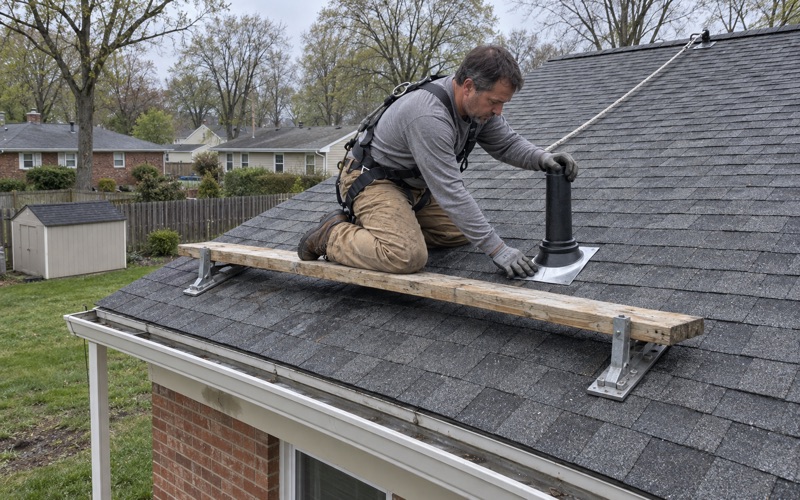
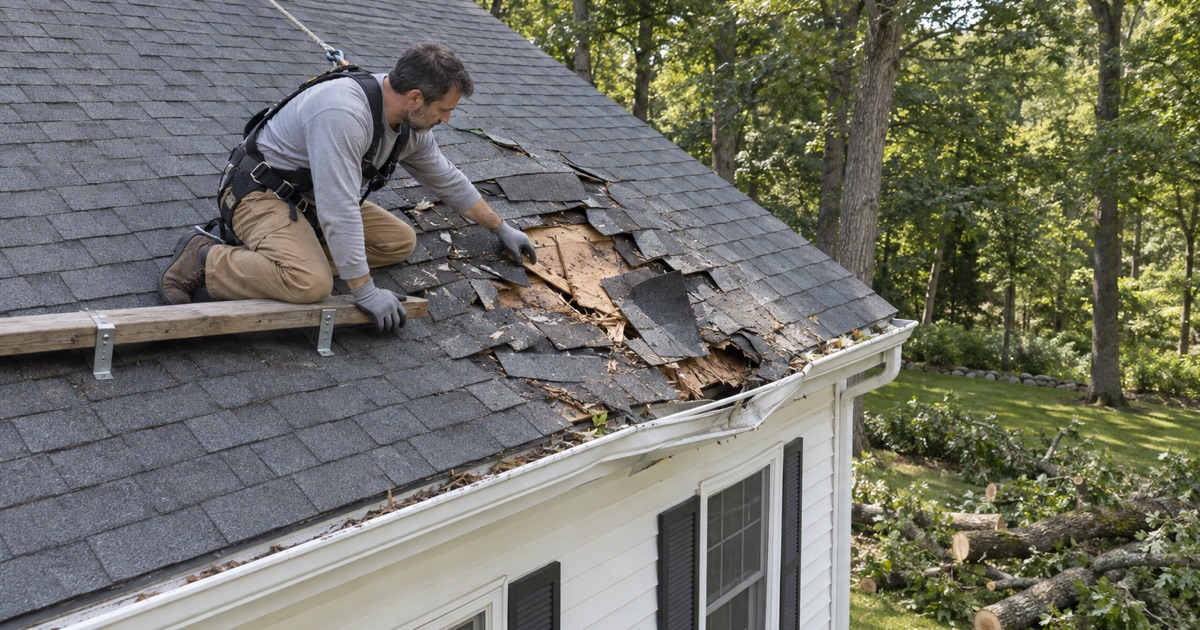
That is where our attic inspection earns its keep. Tracing a leak to a failed vent boot, a torn ridge cap or a section of decking that let go under wind gives the owner a clear, physical answer about the source. It also keeps roof water from being written off as something a flood policy should have handled.
Roof Storm Damage Is a Homeowners-Policy Question
Whether or not your house is among the properties no longer required to carry flood coverage after 2016, roof storm damage is a homeowners-policy matter. That is the general structure of New Jersey property insurance rather than a fact about any one address, and the details of your coverage, deductible and exclusions are in your own policy documents. We do not advise anyone on what coverage to keep or drop.
Two practical points follow from that. Some New Jersey homeowners policies carry a separate hurricane deductible, and the rules for when it applies are set under N.J.A.C. 11:2-42, so the declarations page is worth reading before a claim is filed. And because a roof claim turns on the cause of the damage, the earlier the roof is looked at after a storm, the easier it is to separate fresh wind damage from older wear.
What we do and what we do not do
We photograph and write up storm damage for the owner’s own claim, and when you ask, our crew will meet the insurance adjuster at the house to point out what we found on the roof. What we will not do is negotiate the claim. New Jersey’s Public Adjusters’ Licensing Act, N.J.S.A. 17:22B, governs who may act for an insured in settling a claim, and a roofing contractor is not that person.
Keeping those roles separate protects you. The claim stays yours, the conversation with the carrier stays yours, and our part is to give you an accurate record of the roof’s condition and a clear scope for the repair. The New Jersey Department of Banking and Insurance publishes storm claims guidance that is worth reading before you file.
Repair, replacement and the scope you compare
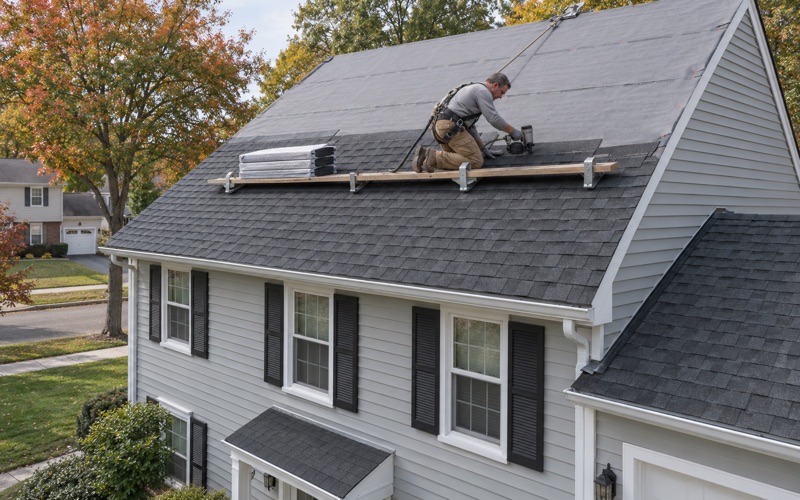
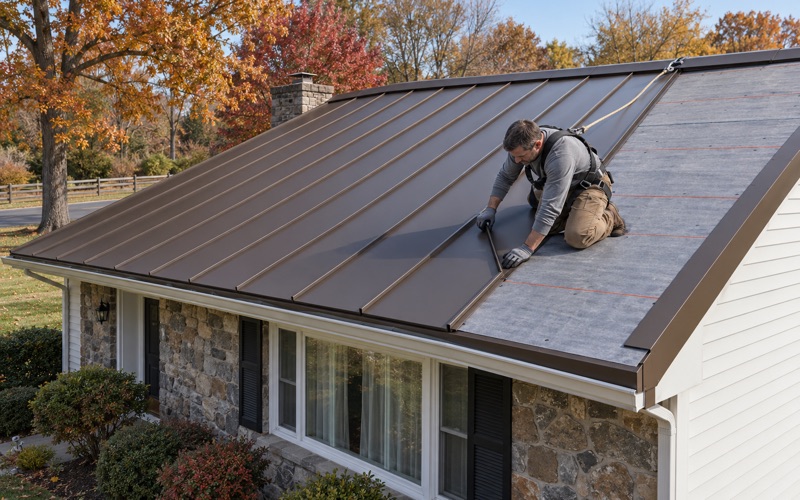
Not every storm claim ends in a new roof. Wind often damages a section, and a well-matched repair is the right answer when the rest of the field is sound. When replacement is warranted, our written scope lists tear-off, decking, underlayment, flashing, ventilation and gutters as separate lines, so an adjuster’s estimate and ours can be compared item by item.
Step, counter and chimney flashing is replaced with a new roof rather than reused, and attic ventilation is checked on every replacement. For a detached one- or two-family house, replacing the roof covering is ordinary maintenance under N.J.A.C. 5:23-2.7, so no permit or inspection is required. Attached houses and buildings of three or more units are a different matter with the Bound Brook Building Department at Borough Hall, 230 Hamilton Street.
Documenting Roof Damage After a Raritan Storm
Bound Brook’s housing makes documentation more involved than in a town of all single-family homes. Of the borough’s 4,707 housing units, 27.6 percent were built in 1939 or earlier, and 1,275 units sit in two-to-four-unit buildings. Older framing, layers of past repairs and shared roof lines all show up in photographs, and an adjuster needs to see which damage is new.
What our storm write-up includes
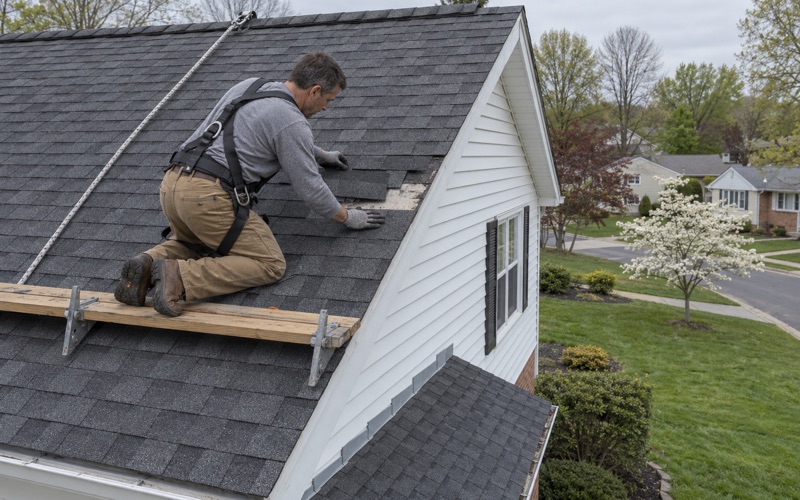
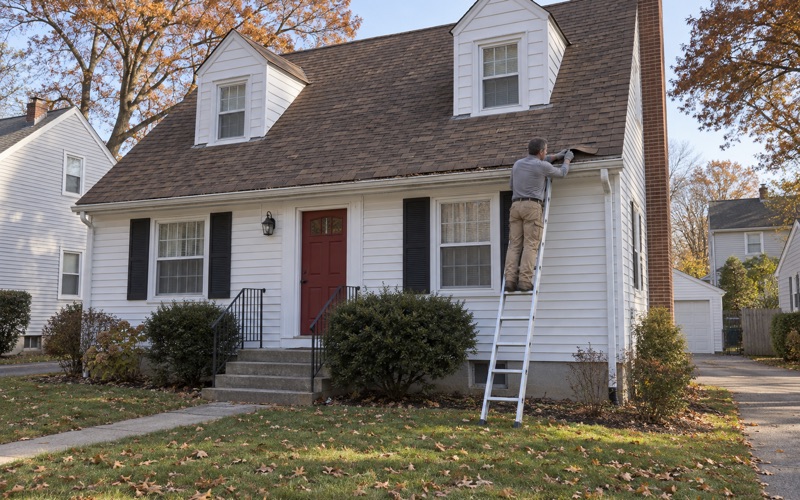
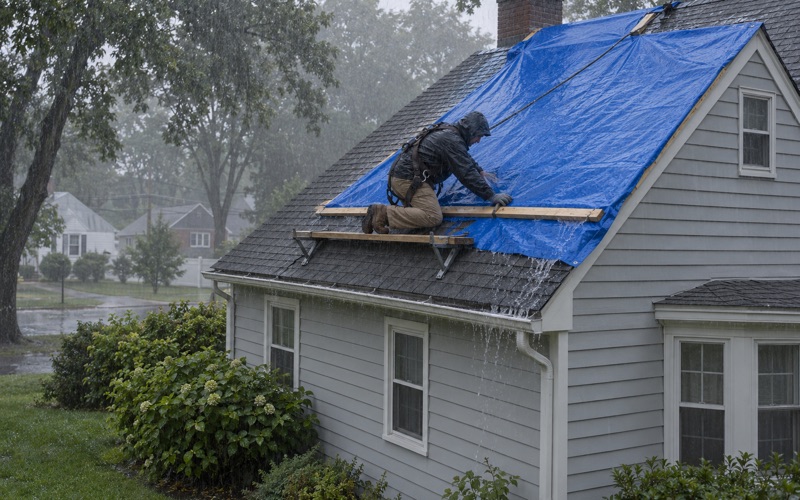
We start in the attic, photographing water staining, wet insulation and daylight at the decking before anything is touched. Then we go up and photograph each damaged area in context: a wide shot that places it on the roof, a close shot of the shingle, flashing or vent, and a note tying both to the leak path traced below.
The write-up lists what failed, where, and what the repair or replacement would involve, dated to our visit. If damaged decking turns up once old material is off, we photograph it and show you before it is replaced, at a per-sheet price already set in the contract, so nothing on the final invoice comes as a surprise.
Older Bound Brook houses add one more thing to the record. Under New Jersey’s rehabilitation subcode, N.J.A.C. 5:23-6, a roof that already carries two or more layers, or one of slate, wood shake or tile, is torn off rather than covered over, so the number of existing layers belongs in the write-up from the start. We count them at an edge or a vent opening and note it, because it changes the scope an adjuster is pricing.
Attached homes and shared walls
In a borough where 449 units are single-family attached homes and many more share a building, a storm rarely damages just one owner’s roof. We plan townhouse and attached-home work with the neighbors’ roofs and the shared wall in mind, and we photograph where one section ends and the next begins, so each owner’s record shows their own roof.
Where an association may hold the roof, we check its documents before writing an estimate. Contracts follow New Jersey’s home improvement rules, including the three-day cancellation notice, and the driveway, yard and gutters are cleaned every work day, with a magnet sweep for nails. After the next storm in Somerset County’s NWS forecast zone, call us to have the roof looked at before the ceiling stain spreads.
- 20+ Years on the Roof
- Free Written Estimates
- NJ and PA Contracts